


 癌症的基本特征包括细胞增殖、血管生成、迁移、凋亡逃避机制和细胞永生等。找到癌症发生过程中这些通路的关键标记物和对应的抗体用于检测至关重要。
 为您推荐一个泛素化位点预测神器——泛素化分析工具,可以为您的蛋白的泛素化位点作出预测和评分。
 细胞自噬受体图形绘图工具为你的蛋白的细胞受体结合位点作出预测和评分,识别结合到自噬通路中的蛋白是非常重要的,便于让我们理解自噬在正常生理、病理过程中的作用,如发育、细胞分化、神经退化性疾病、压力条件下、感染和癌症。
PNMA1 Antibody (monoclonal) (M01)
Mouse monoclonal antibody raised against a partial recombinant PNMA1.
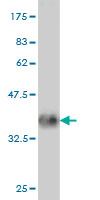
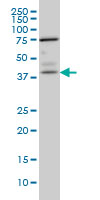
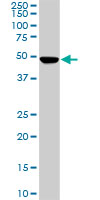
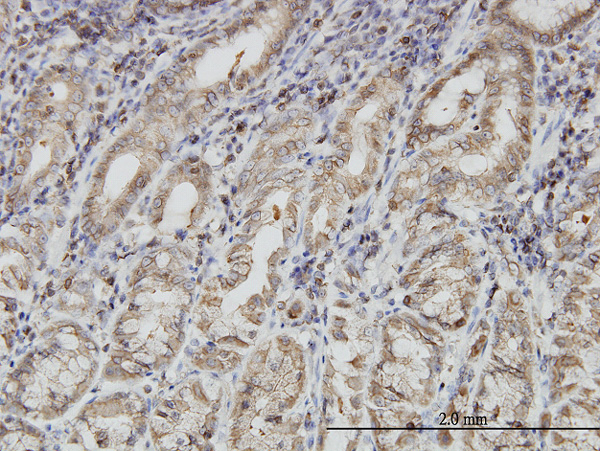
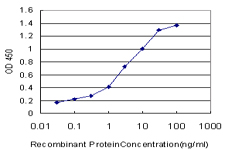
- 产品详情
- 实验流程
- 背景知识
Application 
| WB, IHC, E |
|---|---|
| Primary Accession | Q8ND90 |
| Other Accession | NM_006029 |
| Reactivity | Human, Mouse |
| Host | mouse |
| Clonality | monoclonal |
| Isotype | IgG2a Kappa |
| Clone Names | 4G6 |
| Calculated MW | 39761 Da |
| Gene ID | 9240 |
|---|---|
| Other Names | Paraneoplastic antigen Ma1, 37 kDa neuronal protein, Neuron- and testis-specific protein 1, PNMA1, MA1 |
| Target/Specificity | PNMA1 (NP_006020, 62 a.a. ~ 160 a.a) partial recombinant protein with GST tag. MW of the GST tag alone is 26 KDa. |
| Dilution | WB~~1:500~1000 IHC~~1:100~500 E~~N/A |
| Format | Clear, colorless solution in phosphate buffered saline, pH 7.2 . |
| Storage | Store at -20°C or lower. Aliquot to avoid repeated freezing and thawing. |
| Precautions | PNMA1 Antibody (monoclonal) (M01) is for research use only and not for use in diagnostic or therapeutic procedures. |
For Research Use Only. Not For Use In Diagnostic Procedures.
Provided below are standard protocols that you may find useful for product applications.
BACKGROUND
The PNMA1 gene encodes an antineuronal antibody (anti-Ma) present in patients with paraneoplastic neurologic disorders (Dalmau et al., 1999 [PubMed 10050892]). Some paraneoplastic syndromes affecting the nervous system are associated with antibodies that react with neuronal proteins and the causal tumor (onconeuronal antigens) (summarized by Dalmau et al., 1999 [PubMed 10050892]). Several of these antibodies are markers of specific neurologic syndromes associated with distinct types of cancer. The presence of some antibodies is so specific that disorders previously identified by brain biopsy or at autopsy can be diagnosed serologically. The expression of neuronal proteins by the tumor appears to be a crucial step that breaks the immune tolerance for otherwise normal neuronal proteins. The identity of most onconeuronal antigens was established by probing human cDNA expression libraries with serum containing antineuronal antibodies.
REFERENCES
Toward a confocal subcellular atlas of the human proteome. Barbe L, et al. Mol Cell Proteomics, 2008 Mar. PMID 18029348.A systematic analysis of human CHMP protein interactions: additional MIT domain-containing proteins bind to multiple components of the human ESCRT III complex. Tsang HT, et al. Genomics, 2006 Sep. PMID 16730941.A protein-protein interaction network for human inherited ataxias and disorders of Purkinje cell degeneration. Lim J, et al. Cell, 2006 May 19. PMID 16713569.The human PNMA family: novel neuronal proteins implicated in paraneoplastic neurological disease. Sch?ller M, et al. J Neuroimmunol, 2005 Dec. PMID 16214224.A human protein-protein interaction network: a resource for annotating the proteome. Stelzl U, et al. Cell, 2005 Sep 23. PMID 16169070.

终于等到您。ABCEPTA(百远生物)抗体产品。
点击下方“我要评价 ”按钮提交您的反馈信息,您的反馈和评价是我们最宝贵的财富之一,
我们将在1-3个工作日内处理您的反馈信息。
如有疑问,联系:0512-88856768 tech-china@abcepta.com.


