


 癌症的基本特征包括细胞增殖、血管生成、迁移、凋亡逃避机制和细胞永生等。找到癌症发生过程中这些通路的关键标记物和对应的抗体用于检测至关重要。
 为您推荐一个泛素化位点预测神器——泛素化分析工具,可以为您的蛋白的泛素化位点作出预测和评分。
 细胞自噬受体图形绘图工具为你的蛋白的细胞受体结合位点作出预测和评分,识别结合到自噬通路中的蛋白是非常重要的,便于让我们理解自噬在正常生理、病理过程中的作用,如发育、细胞分化、神经退化性疾病、压力条件下、感染和癌症。
PPARGC1A Antibody (monoclonal) (M03)
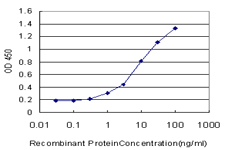
Mouse monoclonal antibody raised against a partial recombinant PPARGC1A.
- 产品详情
- 实验流程
- 背景知识
Application 
| E |
|---|---|
| Primary Accession | Q9UBK2 |
| Other Accession | NM_013261 |
| Host | Mouse |
| Isotype | IgG2a Kappa |
| Clone Names | 1F3 |
| Calculated MW | 91027 Da |
| Gene ID | 10891 |
|---|---|
| Other Names | Peroxisome proliferator-activated receptor gamma coactivator 1-alpha, PGC-1-alpha, PPAR-gamma coactivator 1-alpha, PPARGC-1-alpha, Ligand effect modulator 6, PPARGC1A, LEM6, PGC1, PGC1A, PPARGC1 |
| Target/Specificity | PPARGC1A (NP_037393, 689 a.a. ~ 798 a.a) partial recombinant protein with GST tag. MW of the GST tag alone is 26 KDa. |
| Dilution | E~~N/A |
| Format | Clear, colorless solution in phosphate buffered saline, pH 7.2 . |
| Storage | Store at -20°C or lower. Aliquot to avoid repeated freezing and thawing. |
| Precautions | PPARGC1A Antibody (monoclonal) (M03) is for research use only and not for use in diagnostic or therapeutic procedures. |
For Research Use Only. Not For Use In Diagnostic Procedures.
Provided below are standard protocols that you may find useful for product applications.
BACKGROUND
The protein encoded by this gene is a transcriptional coactivator that regulates the genes involved in energy metabolism. This protein interacts with PPARgamma, which permits the interaction of this protein with multiple transcription factors. This protein can interact with, and regulate the activities of, cAMP response element binding protein (CREB) and nuclear respiratory factors (NRFs). It provides a direct link between external physiological stimuli and the regulation of mitochondrial biogenesis, and is a major factor that regulates muscle fiber type determination. This protein may be also involved in controlling blood pressure, regulating cellular cholesterol homoeostasis, and the development of obesity.
REFERENCES
Associations of markers in 11 obesity candidate genes with maximal weight loss and weight regain in the SOS bariatric surgery cases. Sarzynski MA, et al. Int J Obes (Lond), 2010 Aug 24. PMID 20733583.COMMON VARIANTS IN 40 GENES ASSESSED FOR DIABETES INCIDENCE AND RESPONSE TO METFORMIN AND LIFESTYLE INTERVENTIONS IN THE DIABETES PREVENTION PROGRAM. Jablonski KA, et al. Diabetes, 2010 Aug 3. PMID 20682687.Pharmacogenetic analysis of lipid responses to rosuvastatin in Chinese patients. Hu M, et al. Pharmacogenet Genomics, 2010 Oct. PMID 20679960.An approach based on a genome-wide association study reveals candidate loci for narcolepsy. Shimada M, et al. Hum Genet, 2010 Oct. PMID 20677014.Mitochondrial biogenesis related endurance genotype score and sports performance in athletes. Eynon N, et al. Mitochondrion, 2010 Jul 18. PMID 20647061.

终于等到您。ABCEPTA(百远生物)抗体产品。
点击下方“我要评价 ”按钮提交您的反馈信息,您的反馈和评价是我们最宝贵的财富之一,
我们将在1-3个工作日内处理您的反馈信息。
如有疑问,联系:0512-88856768 tech-china@abcepta.com.


