


 癌症的基本特征包括细胞增殖、血管生成、迁移、凋亡逃避机制和细胞永生等。找到癌症发生过程中这些通路的关键标记物和对应的抗体用于检测至关重要。
 为您推荐一个泛素化位点预测神器——泛素化分析工具,可以为您的蛋白的泛素化位点作出预测和评分。
 细胞自噬受体图形绘图工具为你的蛋白的细胞受体结合位点作出预测和评分,识别结合到自噬通路中的蛋白是非常重要的,便于让我们理解自噬在正常生理、病理过程中的作用,如发育、细胞分化、神经退化性疾病、压力条件下、感染和癌症。
RAD17 Antibody (monoclonal) (M01)
Mouse monoclonal antibody raised against a partial recombinant RAD17.
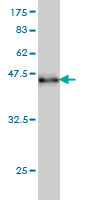
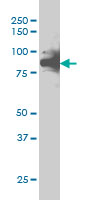
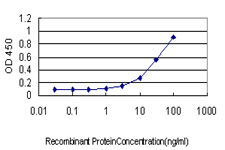
- 产品详情
- 实验流程
- 背景知识
Application 
| WB, E |
|---|---|
| Primary Accession | O75943 |
| Other Accession | BC032304 |
| Reactivity | Human |
| Host | mouse |
| Clonality | monoclonal |
| Isotype | IgG1 Kappa |
| Clone Names | 2G12 |
| Calculated MW | 77055 Da |
| Gene ID | 5884 |
|---|---|
| Other Names | Cell cycle checkpoint protein RAD17, hRad17, RF-C/activator 1 homolog, RAD17, R24L |
| Target/Specificity | RAD17 (AAH32304, 1 a.a. ~ 110 a.a) partial recombinant protein with GST tag. MW of the GST tag alone is 26 KDa. |
| Dilution | WB~~1:500~1000 E~~N/A |
| Format | Clear, colorless solution in phosphate buffered saline, pH 7.2 . |
| Storage | Store at -20°C or lower. Aliquot to avoid repeated freezing and thawing. |
| Precautions | RAD17 Antibody (monoclonal) (M01) is for research use only and not for use in diagnostic or therapeutic procedures. |
For Research Use Only. Not For Use In Diagnostic Procedures.
Provided below are standard protocols that you may find useful for product applications.
BACKGROUND
The protein encoded by this gene is highly similar to the gene product of Schizosaccharomyces pombe rad17, a cell cycle checkpoint gene required for cell cycle arrest and DNA damage repair in response to DNA damage. This protein shares strong similarity with DNA replication factor C (RFC), and can form a complex with RFCs. This protein binds to chromatin prior to DNA damage and is phosphorylated by the checkpoint kinase ATR following damage. This protein recruits the RAD1-RAD9-HUS1 checkpoint protein complex onto chromatin after DNA damage, which may be required for its phosphorylation. The phosphorylation of this protein is required for the DNA-damage-induced cell cycle G2 arrest, and is thought to be a critical early event during checkpoint signaling in DNA-damaged cells. Eight alternatively spliced transcript variants of this gene, which encode four distinct proteins, have been reported. Two pseudogenes, located on chromosomes 7 and 13, have been identified.
REFERENCES
Proteolysis of Rad17 by Cdh1/APC regulates checkpoint termination and recovery from genotoxic stress. Zhang L, et al. EMBO J, 2010 May 19. PMID 20424596.Defining the human deubiquitinating enzyme interaction landscape. Sowa ME, et al. Cell, 2009 Jul 23. PMID 19615732.Evaluating new candidate SNPs as low penetrance risk factors in sporadic breast cancer: a two-stage Spanish case-control study. Vega A, et al. Gynecol Oncol, 2009 Jan. PMID 18950845.The human homolog of fission yeast Rad17 is implicated in tumor growth. Beretta GL, et al. Cancer Lett, 2008 Aug 8. PMID 18378394.DNA damage-induced ubiquitylation of RFC2 subunit of replication factor C complex. Tomida J, et al. J Biol Chem, 2008 Apr 4. PMID 18245774.

终于等到您。ABCEPTA(百远生物)抗体产品。
点击下方“我要评价 ”按钮提交您的反馈信息,您的反馈和评价是我们最宝贵的财富之一,
我们将在1-3个工作日内处理您的反馈信息。
如有疑问,联系:0512-88856768 tech-china@abcepta.com.


