


 癌症的基本特征包括细胞增殖、血管生成、迁移、凋亡逃避机制和细胞永生等。找到癌症发生过程中这些通路的关键标记物和对应的抗体用于检测至关重要。
 为您推荐一个泛素化位点预测神器——泛素化分析工具,可以为您的蛋白的泛素化位点作出预测和评分。
 细胞自噬受体图形绘图工具为你的蛋白的细胞受体结合位点作出预测和评分,识别结合到自噬通路中的蛋白是非常重要的,便于让我们理解自噬在正常生理、病理过程中的作用,如发育、细胞分化、神经退化性疾病、压力条件下、感染和癌症。
ST14 Antibody (monoclonal) (M05)
Mouse monoclonal antibody raised against a partial recombinant ST14.
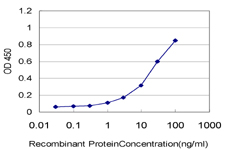
- 产品详情
- 实验流程
- 背景知识
Application 
| E |
|---|---|
| Primary Accession | Q9Y5Y6 |
| Other Accession | NM_021978 |
| Reactivity | Human |
| Host | mouse |
| Clonality | monoclonal |
| Isotype | IgG2a Kappa |
| Clone Names | 2F4 |
| Calculated MW | 94770 Da |
| Gene ID | 6768 |
|---|---|
| Other Names | Suppressor of tumorigenicity 14 protein, Matriptase, Membrane-type serine protease 1, MT-SP1, Prostamin, Serine protease 14, Serine protease TADG-15, Tumor-associated differentially-expressed gene 15 protein, ST14, PRSS14, SNC19, TADG15 |
| Target/Specificity | ST14 (NP_068813, 298 a.a. ~ 400 a.a) partial recombinant protein with GST tag. MW of the GST tag alone is 26 KDa. |
| Dilution | E~~N/A |
| Format | Clear, colorless solution in phosphate buffered saline, pH 7.2 . |
| Storage | Store at -20°C or lower. Aliquot to avoid repeated freezing and thawing. |
| Precautions | ST14 Antibody (monoclonal) (M05) is for research use only and not for use in diagnostic or therapeutic procedures. |
For Research Use Only. Not For Use In Diagnostic Procedures.
Provided below are standard protocols that you may find useful for product applications.
BACKGROUND
The protein encoded by this gene is an epithelial-derived, integral membrane serine protease. This protease forms a complex with the Kunitz-type serine protease inhibitor, HAI-1, and is found to be activated by sphingosine 1-phosphate. This protease has been shown to cleave and activate hepatocyte growth factor/scattering factor, and urokinase plasminogen activator, which suggest the function of this protease as an epithelial membrane activator for other proteases and latent growth factors. The expression of this protease has been associated with breast, colon, prostate, and ovarian tumors, which implicates its role in cancer invasion, and metastasis.
REFERENCES
1.Novel surface targets and serum biomarkers from the ovarian cancer vasculature.Sasaroli D, Gimotty PA, Pathak HB, Hammond R, Kougioumtzidou E, Katsaros D, Buckanovich R, Devarajan K, Sandaltzopoulos R, Godwin AK, Scholler N, Coukos G.Cancer Biol Ther. 2011 Aug 1;12(3):169-80. Epub 2011 Aug 1.

终于等到您。ABCEPTA(百远生物)抗体产品。
点击下方“我要评价 ”按钮提交您的反馈信息,您的反馈和评价是我们最宝贵的财富之一,
我们将在1-3个工作日内处理您的反馈信息。
如有疑问,联系:0512-88856768 tech-china@abcepta.com.


