


 癌症的基本特征包括细胞增殖、血管生成、迁移、凋亡逃避机制和细胞永生等。找到癌症发生过程中这些通路的关键标记物和对应的抗体用于检测至关重要。
 为您推荐一个泛素化位点预测神器——泛素化分析工具,可以为您的蛋白的泛素化位点作出预测和评分。
 细胞自噬受体图形绘图工具为你的蛋白的细胞受体结合位点作出预测和评分,识别结合到自噬通路中的蛋白是非常重要的,便于让我们理解自噬在正常生理、病理过程中的作用,如发育、细胞分化、神经退化性疾病、压力条件下、感染和癌症。
TARS Antibody (monoclonal) (M01)
Mouse monoclonal antibody raised against a partial recombinant TARS.
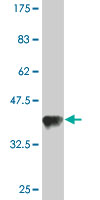
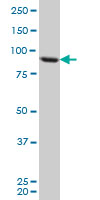
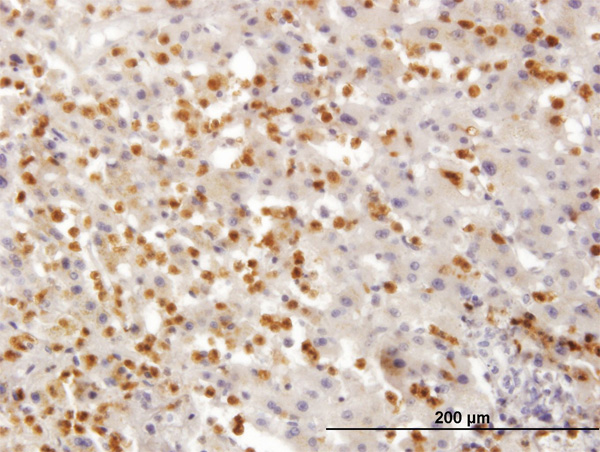
- 产品详情
- 实验流程
- 背景知识
Application 
| WB, IHC |
|---|---|
| Primary Accession | P26639 |
| Other Accession | NM_152295 |
| Reactivity | Human |
| Host | mouse |
| Clonality | monoclonal |
| Isotype | IgG2a Kappa |
| Clone Names | 1A9 |
| Calculated MW | 83435 Da |
| Gene ID | 6897 |
|---|---|
| Other Names | Threonine--tRNA ligase, cytoplasmic, Threonyl-tRNA synthetase, ThrRS, TARS |
| Target/Specificity | TARS (NP_689508, 44 a.a. ~ 143 a.a) partial recombinant protein with GST tag. MW of the GST tag alone is 26 KDa. |
| Dilution | WB~~1:500~1000 IHC~~1:100~500 |
| Format | Clear, colorless solution in phosphate buffered saline, pH 7.2 . |
| Storage | Store at -20°C or lower. Aliquot to avoid repeated freezing and thawing. |
| Precautions | TARS Antibody (monoclonal) (M01) is for research use only and not for use in diagnostic or therapeutic procedures. |
For Research Use Only. Not For Use In Diagnostic Procedures.
Provided below are standard protocols that you may find useful for product applications.
BACKGROUND
Aminoacyl-tRNA synthetases catalyze the aminoacylation of tRNA by their cognate amino acid. Because of their central role in linking amino acids with nucleotide triplets contained in tRNAs, aminoacyl-tRNA synthetases are thought to be among the first proteins that appeared in evolution. Threonyl-tRNA synthetase belongs to the class-II aminoacyl-tRNA synthetase family
REFERENCES
Large-scale mapping of human protein-protein interactions by mass spectrometry. Ewing RM, et al. Mol Syst Biol, 2007. PMID 17353931.Proteomics analysis of the interactome of N-myc downstream regulated gene 1 and its interactions with the androgen response program in prostate cancer cells. Tu LC, et al. Mol Cell Proteomics, 2007 Apr. PMID 17220478.The proteomic reactor facilitates the analysis of affinity-purified proteins by mass spectrometry: application for identifying ubiquitinated proteins in human cells. Vasilescu J, et al. J Proteome Res, 2007 Jan. PMID 17203973.The status, quality, and expansion of the NIH full-length cDNA project: the Mammalian Gene Collection (MGC). Gerhard DS, et al. Genome Res, 2004 Oct. PMID 15489334.Complete sequencing and characterization of 21,243 full-length human cDNAs. Ota T, et al. Nat Genet, 2004 Jan. PMID 14702039.

终于等到您。ABCEPTA(百远生物)抗体产品。
点击下方“我要评价 ”按钮提交您的反馈信息,您的反馈和评价是我们最宝贵的财富之一,
我们将在1-3个工作日内处理您的反馈信息。
如有疑问,联系:0512-88856768 tech-china@abcepta.com.


