


 癌症的基本特征包括细胞增殖、血管生成、迁移、凋亡逃避机制和细胞永生等。找到癌症发生过程中这些通路的关键标记物和对应的抗体用于检测至关重要。
 为您推荐一个泛素化位点预测神器——泛素化分析工具,可以为您的蛋白的泛素化位点作出预测和评分。
 细胞自噬受体图形绘图工具为你的蛋白的细胞受体结合位点作出预测和评分,识别结合到自噬通路中的蛋白是非常重要的,便于让我们理解自噬在正常生理、病理过程中的作用,如发育、细胞分化、神经退化性疾病、压力条件下、感染和癌症。
TNXB Antibody (monoclonal) (M01)
Mouse monoclonal antibody raised against a full length recombinant TNXB.
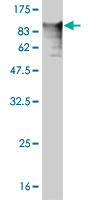
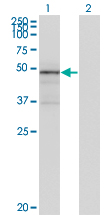
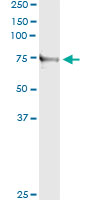

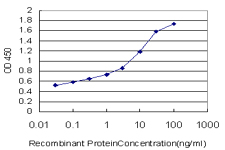
- 产品详情
- 实验流程
- 背景知识
Application 
| WB, IP, E |
|---|---|
| Primary Accession | P22105 |
| Other Accession | BC033740 |
| Reactivity | Human |
| Host | mouse |
| Clonality | monoclonal |
| Isotype | IgG2a Kappa |
| Clone Names | 2D3-1B10 |
| Calculated MW | 458388 Da |
| Gene ID | 7148 |
|---|---|
| Other Names | Tenascin-X, TN-X, Hexabrachion-like protein, TNXB, HXBL, TNX, TNXB1, TNXB2, XB |
| Target/Specificity | TNXB (AAH33740, 1 a.a. ~ 673 a.a) full-length recombinant protein with GST tag. MW of the GST tag alone is 26 KDa. |
| Dilution | WB~~1:500~1000 IP~~N/A E~~N/A |
| Format | Clear, colorless solution in phosphate buffered saline, pH 7.2 . |
| Storage | Store at -20°C or lower. Aliquot to avoid repeated freezing and thawing. |
| Precautions | TNXB Antibody (monoclonal) (M01) is for research use only and not for use in diagnostic or therapeutic procedures. |
For Research Use Only. Not For Use In Diagnostic Procedures.
Provided below are standard protocols that you may find useful for product applications.
BACKGROUND
This gene encodes a member of the tenascin family of extracellular matrix glycoproteins. The tenascins have anti-adhesive effects, as opposed to fibronectin which is adhesive. This protein is thought to function in matrix maturation during wound healing, and its deficiency has been associated with the connective tissue disorder Ehlers-Danlos syndrome. This gene localizes to the major histocompatibility complex (MHC) class III region on chromosome 6. It is one of four genes in this cluster which have been duplicated. The duplicated copy of this gene is incomplete and is a pseudogene which is transcribed but does not encode a protein. The structure of this gene is unusual in that it overlaps the CREBL1 and CYP21A2 genes at its 5' and 3' ends, respectively. Multiple transcript variants encoding different isoforms have been found for this gene.
REFERENCES
Variation at the NFATC2 Locus Increases the Risk of Thiazolinedinedione-Induced Edema in the Diabetes REduction Assessment with ramipril and rosiglitazone Medication (DREAM) Study. Bailey SD, et al. Diabetes Care, 2010 Jul 13. PMID 20628086.Examination of genetic polymorphisms in newborns for signatures of sex-specific prenatal selection. Ucisik-Akkaya E, et al. Mol Hum Reprod, 2010 Oct. PMID 20587610.Common genetic variation and the control of HIV-1 in humans. Fellay J, et al. PLoS Genet, 2009 Dec. PMID 20041166.Gene-centric association signals for lipids and apolipoproteins identified via the HumanCVD BeadChip. Talmud PJ, et al. Am J Hum Genet, 2009 Nov. PMID 19913121.Genetic evidence for a role of IL33 in nasal polyposis. Buysschaert ID, et al. Allergy, 2010 May. PMID 19860791.

终于等到您。ABCEPTA(百远生物)抗体产品。
点击下方“我要评价 ”按钮提交您的反馈信息,您的反馈和评价是我们最宝贵的财富之一,
我们将在1-3个工作日内处理您的反馈信息。
如有疑问,联系:0512-88856768 tech-china@abcepta.com.


