


 癌症的基本特征包括细胞增殖、血管生成、迁移、凋亡逃避机制和细胞永生等。找到癌症发生过程中这些通路的关键标记物和对应的抗体用于检测至关重要。
 为您推荐一个泛素化位点预测神器——泛素化分析工具,可以为您的蛋白的泛素化位点作出预测和评分。
 细胞自噬受体图形绘图工具为你的蛋白的细胞受体结合位点作出预测和评分,识别结合到自噬通路中的蛋白是非常重要的,便于让我们理解自噬在正常生理、病理过程中的作用,如发育、细胞分化、神经退化性疾病、压力条件下、感染和癌症。
Anti-NMU Picoband Antibody
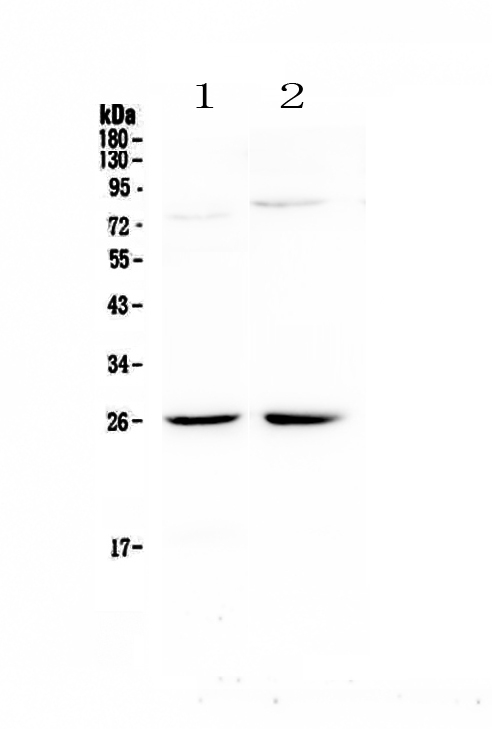
- 产品详情
- 实验流程
- 背景知识
Application 
| WB |
|---|---|
| Primary Accession | P48645 |
| Host | Rabbit |
| Reactivity | Mouse, Rat |
| Clonality | Polyclonal |
| Format | Lyophilized |
| Description | Rabbit IgG polyclonal antibody for NMU detection. Tested with WB in Human;Mouse;Rat. |
| Reconstitution | Add 0.2ml of distilled water will yield a concentration of 500ug/ml. |
| Gene ID | 10874 |
|---|---|
| Other Names | Neuromedin-U, Neuromedin-U-25, NmU-25, NMU |
| Calculated MW | 19741 Da |
| Application Details | Western blot, 0.1-0.5 µg/ml |
| Subcellular Localization | Secreted. |
| Tissue Specificity | Expressed throughout the enteric nervous system with highest levels being found in the jejunum. |
| Source | Eukaryota |
| Contents | Each vial contains 4mg Trehalose, 0.9mg NaCl, 0.2mg Na2HPO4, 0.05mg NaN3. |
| Immunogen | A synthetic peptide corresponding to a sequence of human NMU (FRVDEEFQSPFASQSRGYFLFRPRN). |
| Cross Reactivity | No cross reactivity with other proteins. |
| Storage | At -20˚C; for one year. After r˚Constitution, at 4˚C; for one month. It˚Can also be aliquotted and stored frozen at -20˚C; for a longer time. Avoid repeated freezing and thawing. |
For Research Use Only. Not For Use In Diagnostic Procedures.
| Name | NMU (HGNC:7859) |
|---|---|
| Function | [Neuromedin-U-25]: Multifunctional neuropeptide that acts via two G protein-coupled receptors, NMUR1 and NMUR2 (PubMed:15331768, PubMed:35440625). Functionally, is involved in pleiotropic roles, including regulation of feeding, energy balance, blood pressure and smooth muscle contraction (By similarity). Additionally modulates hormone release and inflammatory responses in a tissue- and receptor- dependent manner (PubMed:15585845, PubMed:33857254). Mechanistically, binding to NMUR1 or NMUR2 results in coupling of receptors to Galpha proteins, namely GNAQ/Gaq or GNA11/Ga11 and GNAI1/Gai subunits (PubMed:15331768). GNAQ/Gaq or GNA11/Ga11 coupling leads to the activation of a phospholipase C (PLC), which hydrolyzes PIP2 (phosphatidylinositol 4,5-bisphosphate) into DAG (diacylglycerol) and IP3 (inositol trisphosphate), and subsequent intracellular calcium mobilization via IP3 receptors on the endoplasmic reticulum (PubMed:15331768). GNAI1/Gai coupling inhibits forskolin-stimulated cAMP accumulation (PubMed:15331768). In pancreatic beta cells, regulates insulin secretion through NMUR1 coupled to GNAI2 and GNAO1, resulting in reduced intracellular Ca2+ influx and cAMP levels (PubMed:33857254). Through NMUR1 in Th2-type T cells, enhances type 2 cytokine secretion and modulates inflammatory responses via activation of PLC-calcineurin-MEK and PI3K signaling pathways (PubMed:15585845). |
| Cellular Location | [Neuromedin-U-25]: Secreted {ECO:0000250|UniProtKB:P12760} |
| Tissue Location | Expressed throughout the enteric nervous system with highest levels being found in the jejunum. Expressed in gastrointestinal tract (PubMed:7619205). |
Provided below are standard protocols that you may find useful for product applications.
BACKGROUND
Neuromedin U (NMU) is a neuropeptide with potent activity on smooth muscle, which was isolated first from porcine spinal cord and later from other species. It is a member of the neuromedin family of neuropeptides. The encoded protein is a precursor that is proteolytically processed to generate a biologically active neuropeptide that plays a role in pain, stress, immune-mediated inflammatory diseases and feeding regulation. Increased expression of this gene was observed in renal, pancreatic and lung cancers. Alternative splicing results in multiple transcript variants encoding different isoforms. Some of these isoforms may undergo similar processing to generate the mature peptide.

终于等到您。ABCEPTA(百远生物)抗体产品。
点击下方“我要评价 ”按钮提交您的反馈信息,您的反馈和评价是我们最宝贵的财富之一,
我们将在1-3个工作日内处理您的反馈信息。
如有疑问,联系:0512-88856768 tech-china@abcepta.com.


