


 癌症的基本特征包括细胞增殖、血管生成、迁移、凋亡逃避机制和细胞永生等。找到癌症发生过程中这些通路的关键标记物和对应的抗体用于检测至关重要。
 为您推荐一个泛素化位点预测神器——泛素化分析工具,可以为您的蛋白的泛素化位点作出预测和评分。
 细胞自噬受体图形绘图工具为你的蛋白的细胞受体结合位点作出预测和评分,识别结合到自噬通路中的蛋白是非常重要的,便于让我们理解自噬在正常生理、病理过程中的作用,如发育、细胞分化、神经退化性疾病、压力条件下、感染和癌症。
Anti-Desmoplakin Rabbit Monoclonal Antibody
- 产品详情
- 实验流程
Application 
| WB, IF, ICC, FC |
|---|---|
| Primary Accession | P15924 |
| Host | Rabbit |
| Isotype | IgG |
| Reactivity | Rat, Human |
| Clonality | Monoclonal |
| Format | Liquid |
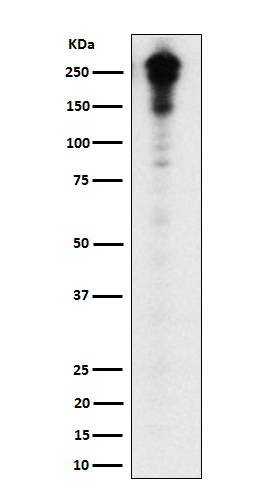
| Description | Anti-Desmoplakin Rabbit Monoclonal Antibody . Tested in WB, ICC/IF, Flow Cytometry applications. This antibody reacts with Human, Rat. |
| Gene ID | 1832 |
|---|---|
| Other Names | Desmoplakin, DP, 250/210 kDa paraneoplastic pemphigus antigen, DSP |
| Calculated MW | 331774 Da |
| Application Details | WB 1:500-1:2000 ICC/IF 1:50-1:200 FC 1:50 |
| Source | Eukaryota |
| Contents | Rabbit IgG in phosphate buffered saline, pH 7.4, 150mM NaCl, 0.02% sodium azide and 50% glycerol, 0.4-0.5mg/ml BSA. |
| Clone Names | Clone: 22D49 |
| Immunogen | A synthesized peptide derived from human Desmoplakin |
| Purification | Affinity-chromatography |
| Storage | Store at -20°C for one year. For short term storage and frequent use, store at 4°C for up to one month. Avoid repeated freeze-thaw cycles. |
For Research Use Only. Not For Use In Diagnostic Procedures.
| Name | DSP (HGNC:3052) |
|---|---|
| Function | A component of desmosome cell-cell junctions which are required for positive regulation of cellular adhesion (PubMed:25733715). Critical for cell-cell adhesion in early stage blastocysts and progression through proamniotic cavity formation (By similarity). Not required for preimplantation morphogenic process in blastocysts (By similarity). Required for keratin filament anchoring at the desmosome junction and subsequent organization of the keratin intermediate filament network within the cytoplasm (By similarity). Required for anchoring of desmosomes to the microtubule architecture, via its interaction with NIN (By similarity). Promotes microtubule- mediated GJA1/CX43 trafficking to cell membranes via its interaction with MAPRE1/EB1, thereby facilitating gap junction intracellular communication (PubMed:25225338). Plays a key role in adhesion and organization of the dermal epithelial barrier (PubMed:26604139). Critical for the maintenance of the neural tube structure following formation and organization of the neuroepithelium (By similarity). Facilitates outgrowth and repair of motor neuron fibers in regenerating axons following injury, probably by promoting recruitment of a complex containing DSP, CDH2, VIM and JUP to the outgrowth tips (By similarity). Critical for the normal formation of heart and myocardial tissue during early embryogenesis (By similarity). Also required for development of vascular capillary structures and intact endothelial cell barriers (By similarity). Regulates profibrotic gene expression in cardiomyocytes via activation of the MAPK14/p38 MAPK signaling cascade and increase in TGFB1 protein abundance (By similarity). Maintains cardiac rhythmicity by ensuring correct cell-cell adhesion within the sinoatrial node, via stabilization of protein components of both desmosome and Gap junctions (By similarity). Involved in maintaining the protein stability and recruitment of GJA1 to functional gap junctions, via inhibition of KRAS-mediated MAPK1/MAPK3 phosphorylation of GJA1 (By similarity). Negative regulator of cell cycle progression and differentiation in keratinocytes, potentially via inhibition of MAPK and phosphoinositide-3-kinase (PI3K) signaling pathways (PubMed:17475244). Mediates the interaction between the desmosome and COP9 signalosome complex (CSN) protein complex (PubMed:28891468). As a result of this interaction, promotes keratinocyte differentiation via deneddylation of EGFR resulting in a reduction in EGFR protein stabilization and translocation away from the cell membrane (PubMed:28891468). Required for the maintenance of protein abundance of desmosome junction components DSG1, DSG2, DSC2, DSC3, PKP1, PKP2 and PKP3 (PubMed:17475244, PubMed:26073755). Required for the survival and maintenance of germ cells in the gonads during embryonic development (By similarity). Binds to telomere DNA (via C-terminus) and acts to prevent telomere damage and maintain telomere length via its interaction with TRF2 (PubMed:31595153). |
| Cellular Location | Cell projection, axon {ECO:0000250|UniProtKB:E9Q557}. Cell junction, desmosome. Cell membrane. Cytoplasm. Nucleus. Note=Localizes to desmosome precursor particles in the cytoplasm (PubMed:25208567). Localizes to the cytoplasm in undifferentiated keratinocytes however becomes localizes to both lateral and tricellular cell-cell contacts as differentiation progresses and as epithelial sheet formation completes (By similarity) Localizes to the interface of the cortical keratin network and endodermal cell periphery in developing embryos (By similarity) {ECO:0000250|UniProtKB:E9Q557, ECO:0000269|PubMed:25208567} |
| Tissue Location | Expressed in oral mucosa (at protein level) (PubMed:30479852). Expressed in arrector pili muscle (at protein level) (PubMed:29034528). Expressed in the heart (at protein level) (PubMed:18662195, PubMed:32410525). Expressed in keratinocytes of the skin (at protein level) (PubMed:26604139) [Isoform DPII]: Resides predominantly in tissues and cells of stratified origin |
Research Areas
Application Protocols
Provided below are standard protocols that you may find useful for product applications.

终于等到您。ABCEPTA(百远生物)抗体产品。
点击下方“我要评价 ”按钮提交您的反馈信息,您的反馈和评价是我们最宝贵的财富之一,
我们将在1-3个工作日内处理您的反馈信息。
如有疑问,联系:0512-88856768 tech-china@abcepta.com.


