


 癌症的基本特征包括细胞增殖、血管生成、迁移、凋亡逃避机制和细胞永生等。找到癌症发生过程中这些通路的关键标记物和对应的抗体用于检测至关重要。
 为您推荐一个泛素化位点预测神器——泛素化分析工具,可以为您的蛋白的泛素化位点作出预测和评分。
 细胞自噬受体图形绘图工具为你的蛋白的细胞受体结合位点作出预测和评分,识别结合到自噬通路中的蛋白是非常重要的,便于让我们理解自噬在正常生理、病理过程中的作用,如发育、细胞分化、神经退化性疾病、压力条件下、感染和癌症。
SLC26A5 antibody - middle region
Rabbit Polyclonal Antibody
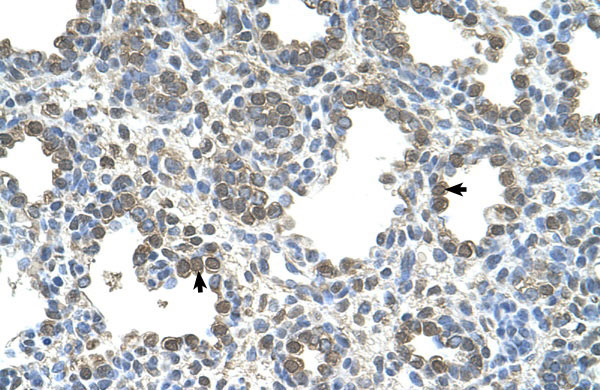
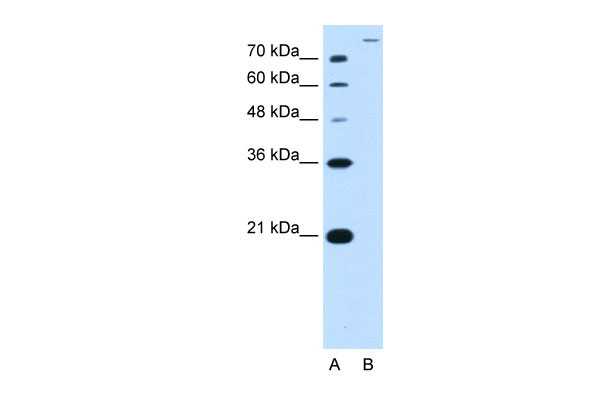
- 产品详情
- 实验流程
Application 
| WB, IHC |
|---|---|
| Primary Accession | P58743 |
| Other Accession | NM_198999, NP_945350 |
| Reactivity | Human, Mouse, Rat, Rabbit, Pig, Dog, Guinea Pig, Horse, Bovine |
| Predicted | Human, Mouse, Rat, Rabbit, Pig, Dog, Guinea Pig, Horse, Bovine |
| Host | Rabbit |
| Clonality | Polyclonal |
| Calculated MW | 81264 Da |
| Gene ID | 375611 |
|---|---|
| Alias Symbol | DFNB61, MGC118886, MGC118887, MGC118888, MGC118889, PRES |
| Other Names | Prestin, Solute carrier family 26 member 5, SLC26A5, PRES |
| Format | Liquid. Purified antibody supplied in 1x PBS buffer with 0.09% (w/v) sodium azide and 2% sucrose. |
| Reconstitution & Storage | Add 100 ul of distilled water. Final anti-SLC26A5 antibody concentration is 1 mg/ml in PBS buffer with 2% sucrose. For longer periods of storage, store at 20°C. Avoid repeat freeze-thaw cycles. |
| Precautions | SLC26A5 antibody - middle region is for research use only and not for use in diagnostic or therapeutic procedures. |
For Research Use Only. Not For Use In Diagnostic Procedures.
| Name | SLC26A5 (HGNC:9359) |
|---|---|
| Synonyms | PRES |
| Function | Voltage-sensitive motor protein that drives outer hair cell (OHC) electromotility (eM) and participates in sound amplification in the hearing organ (By similarity). Converts changes in the transmembrane electric potential into mechanical displacements resulting in the coupling of its expansion to movement of a charged voltage sensor across the lipid membrane (By similarity). The nature of the voltage sensor is not completely clear, and two models compete. In the first model, acts as an incomplete transporter where intracellular chloride anion acts as extrinsic voltage sensor that drives conformational change in the protein which is sufficient to produce a length change in the plane of the membrane and hence in the length of the OHC (By similarity). The second model in which multiple charged amino acid residues are distributed at the intracellular and extracellular membrane interfaces that form an intrinsic voltage sensor, whose movement produces the non-linear capacitance (NLC) (PubMed:34390643). However, the effective voltage sensor may be the result of a hybrid voltage sensor, assembled from intrinsic charge (charged residues) and extrinsic charge (bound anion) (By similarity). Notably, binding of anions to the anion-binding pocket partially neutralizes the intrinsic positive charge rather than to form an electrically negative sensor, therefore remaining charge may serve as voltage sensor that, after depolarization, moves from down (expanded state) to up (contracted) conformation, which is accompanied by an eccentric contraction of the intermembrane cross-sectional area of the protein as well as a major increase in the hydrophobic thickness of the protein having as consequences the plasma membrane thickening and the cell contraction after membrane depolarization (PubMed:34390643). The anion-binding pocket transits from the inward-open (Down) state, where it is exposed toward the intracellular solvent in the absence of anion, to the occluded (Up) state upon anion binding (PubMed:34390643). Salicylate competes for the anion-binding site and inhibits the voltage-sensor movement, and therefore inhibits the charge transfer and electromotility by displacing Cl(-) from the anion-binding site and by preventing the structural transitions to the contracted state (PubMed:34390643). In addition, can act as a weak Cl(-)/HCO3(-) antiporter across the cell membrane and so regulate the intracellular pH of the outer hair cells (OHCs), while firstly found as being unable to mediate electrogenic anion transport (By similarity). Moreover, supports a role in cardiac mechanical amplification serving as an elastic element to enhance the actomyosin- based sarcomere contraction system (By similarity). |
| Cellular Location | Lateral cell membrane; Multi-pass membrane protein. Note=Localized at the lateral cell membrane of outer hair cells (By similarity). Alters profoundly the shape of its surrounding lipid bilayer (PubMed:34390643). {ECO:0000250, ECO:0000250|UniProtKB:Q9JKQ2, ECO:0000269|PubMed:34390643} |
Research Areas
Application Protocols
Provided below are standard protocols that you may find useful for product applications.
REFERENCES
Chambard,J.M.(2005)PflugersArch.450(1),34-44ReconstitutionandStorage:Forshorttermuse,storeat2-8Cupto1week.Forlongtermstorage,storeat-20Cinsmallaliquotstopreventfreeze-thawcycles.

终于等到您。ABCEPTA(百远生物)抗体产品。
点击下方“我要评价 ”按钮提交您的反馈信息,您的反馈和评价是我们最宝贵的财富之一,
我们将在1-3个工作日内处理您的反馈信息。
如有疑问,联系:0512-88856768 tech-china@abcepta.com.


