


 癌症的基本特征包括细胞增殖、血管生成、迁移、凋亡逃避机制和细胞永生等。找到癌症发生过程中这些通路的关键标记物和对应的抗体用于检测至关重要。
 为您推荐一个泛素化位点预测神器——泛素化分析工具,可以为您的蛋白的泛素化位点作出预测和评分。
 细胞自噬受体图形绘图工具为你的蛋白的细胞受体结合位点作出预测和评分,识别结合到自噬通路中的蛋白是非常重要的,便于让我们理解自噬在正常生理、病理过程中的作用,如发育、细胞分化、神经退化性疾病、压力条件下、感染和癌症。
SMURF2 Antibody 精选
Purified Mouse Monoclonal Antibody (Mab)

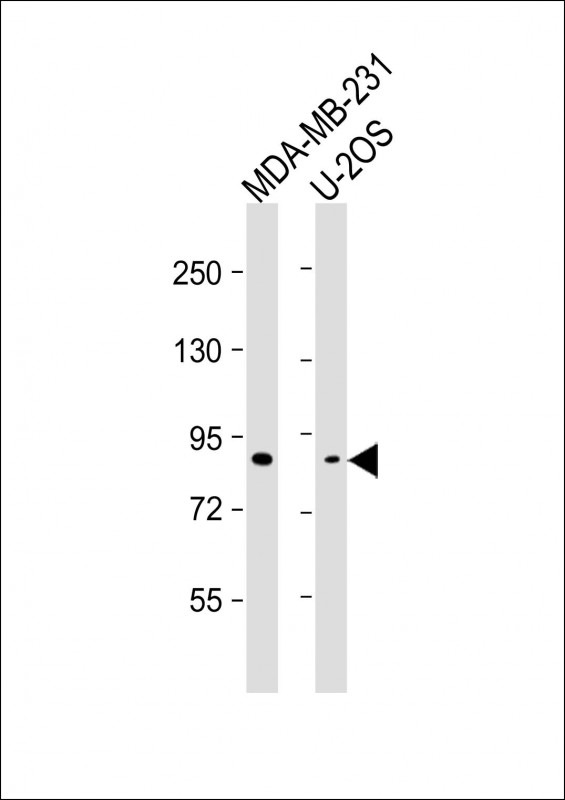
- 产品详情
- 实验流程
- 背景知识
Application 
| WB, E |
|---|---|
| Primary Accession | Q9HAU4 |
| Reactivity | Human, Mouse |
| Predicted | Rat, Bovine, Canine, Rabbit, Chicken |
| Host | Mouse |
| Clonality | monoclonal |
| Isotype | IgG1,k |
| Clone Names | 1826CT865.51.28 |
| Calculated MW | 86196 Da |
| Gene ID | 64750 |
|---|---|
| Other Names | E3 ubiquitin-protein ligase SMURF2, hSMURF2, 6.3.2.-, SMAD ubiquitination regulatory factor 2, SMAD-specific E3 ubiquitin-protein ligase 2, SMURF2 |
| Target/Specificity | This SMURF2 antibody is generated from a mouse immunized with a recombinant protein of human SMURF2. |
| Dilution | WB~~1:2000-1:4000 E~~Use at an assay dependent concentration. |
| Format | Purified monoclonal antibody supplied in PBS with 0.09% (W/V) sodium azide. This antibody is purified through a protein G column, followed by dialysis against PBS. |
| Storage | Maintain refrigerated at 2-8°C for up to 2 weeks. For long term storage store at -20°C in small aliquots to prevent freeze-thaw cycles. |
| Precautions | SMURF2 Antibody is for research use only and not for use in diagnostic or therapeutic procedures. |
For Research Use Only. Not For Use In Diagnostic Procedures.
| Name | SMURF2 (HGNC:16809) |
|---|---|
| Function | E3 ubiquitin-protein ligase which accepts ubiquitin from an E2 ubiquitin-conjugating enzyme in the form of a thioester and then directly transfers the ubiquitin to targeted substrates (PubMed:11016919, PubMed:38016474). Interacts with SMAD7 to trigger SMAD7-mediated transforming growth factor beta/TGF-beta receptor ubiquitin-dependent degradation, thereby down-regulating TGF-beta signaling (PubMed:11163210, PubMed:12717440, PubMed:21791611). In addition, interaction with SMAD7 activates autocatalytic degradation, which is prevented by interaction with AIMP1 (PubMed:18448069). Also forms a stable complex with TGF-beta receptor-mediated phosphorylated SMAD1, SMAD2 and SMAD3, and targets SMAD1 and SMAD2 for ubiquitination and proteasome-mediated degradation (PubMed:11016919, PubMed:11158580, PubMed:11389444). SMAD2 may recruit substrates, such as SNON, for ubiquitin-dependent degradation (PubMed:11389444). Negatively regulates TGFB1-induced epithelial-mesenchymal transition and myofibroblast differentiation (PubMed:30696809). Acts as an activator of ferroptosis by mediating ubiquitination and degradation of GSTP1, thereby preventing detoxification of 4-hydroxynonenal (4-HNE) reactive aldehyde (PubMed:38016474). Acts as a positive regulator of smoothened signaling pathway by mediating ubiquitination of PTCH1, leading to endocytosis and lysosomal degradation of PTCH1 (By similarity). |
| Cellular Location | Nucleus. Cytoplasm. Cell membrane. Membrane raft. Note=Cytoplasmic in the presence of SMAD7. Colocalizes with CAV1, SMAD7 and TGF-beta receptor in membrane rafts |
| Tissue Location | Widely expressed. |
Provided below are standard protocols that you may find useful for product applications.
BACKGROUND
E3 ubiquitin-protein ligase which accepts ubiquitin from an E2 ubiquitin-conjugating enzyme in the form of a thioester and then directly transfers the ubiquitin to targeted substrates. Interacts with SMAD1 and SMAD7 in order to trigger their ubiquitination and proteasome-dependent degradation. In addition, interaction with SMAD7 activates autocatalytic degradation, which is prevented by interaction with SCYE1. Forms a stable complex with the TGF-beta receptor-mediated phosphorylated SMAD2 and SMAD3. In this way, SMAD2 may recruit substrates, such as SNON, for ubiquitin-mediated degradation. Enhances the inhibitory activity of SMAD7 and reduces the transcriptional activity of SMAD2. Coexpression of SMURF2 with SMAD1 results in considerable decrease in steady-state level of SMAD1 protein and a smaller decrease of SMAD2 level.
REFERENCES
Kavsak P.,et al.Mol. Cell 6:1365-1375(2000).
Lin X.,et al.J. Biol. Chem. 275:36818-36822(2000).
Zhang Y.,et al.Proc. Natl. Acad. Sci. U.S.A. 98:974-979(2001).
Bonni S.,et al.Nat. Cell Biol. 3:587-595(2001).
Di Guglielmo G.M.,et al.Nat. Cell Biol. 5:410-421(2003).

终于等到您。ABCEPTA(百远生物)抗体产品。
点击下方“我要评价 ”按钮提交您的反馈信息,您的反馈和评价是我们最宝贵的财富之一,
我们将在1-3个工作日内处理您的反馈信息。
如有疑问,联系:0512-88856768 tech-china@abcepta.com.


