


 癌症的基本特征包括细胞增殖、血管生成、迁移、凋亡逃避机制和细胞永生等。找到癌症发生过程中这些通路的关键标记物和对应的抗体用于检测至关重要。
 为您推荐一个泛素化位点预测神器——泛素化分析工具,可以为您的蛋白的泛素化位点作出预测和评分。
 细胞自噬受体图形绘图工具为你的蛋白的细胞受体结合位点作出预测和评分,识别结合到自噬通路中的蛋白是非常重要的,便于让我们理解自噬在正常生理、病理过程中的作用,如发育、细胞分化、神经退化性疾病、压力条件下、感染和癌症。
SETDB1 Antibody
Purified Mouse Monoclonal Antibody
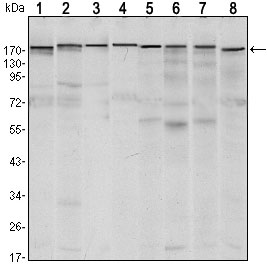
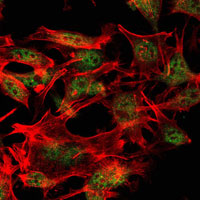
- 产品详情
- 实验流程
Application 
| WB, ICC, E |
|---|---|
| Primary Accession | Q15047 |
| Reactivity | Human, Mouse, Monkey |
| Host | Mouse |
| Clonality | Monoclonal |
| Clone Names | 5H6A12 |
| Isotype | IgG1 |
| Calculated MW | 143157 Da |
| Description | This gene encodes a histone methyltransferase. The encoded enzyme catalyzes the reaction of S-adenosyl-L-methionine and histone L-lysine to produce S-adenosyl-L-homocysteine and histone N(6)-methyl-L-lysine. The encoded protein likely functions in transcriptional repression. Alternatively spliced transcript variants have been described. |
| Immunogen | Purified recombinant fragment of human SETDB1 expressed in E. Coli. |
| Formulation | Ascitic fluid containing 0.03% sodium azide. |
| Gene ID | 9869 |
|---|---|
| Other Names | Histone-lysine N-methyltransferase SETDB1, 2.1.1.43, ERG-associated protein with SET domain, ESET, Histone H3-K9 methyltransferase 4, H3-K9-HMTase 4, Lysine N-methyltransferase 1E, SET domain bifurcated 1, SETDB1, KIAA0067, KMT1E |
| Dilution | WB~~1/500 - 1/2000 ICC~~N/A E~~N/A |
| Storage | Maintain refrigerated at 2-8°C for up to 6 months. For long term storage store at -20°C in small aliquots to prevent freeze-thaw cycles. |
| Precautions | SETDB1 Antibody is for research use only and not for use in diagnostic or therapeutic procedures. |
For Research Use Only. Not For Use In Diagnostic Procedures.
| Name | SETDB1 {ECO:0000303|PubMed:11959841, ECO:0000312|HGNC:HGNC:10761} |
|---|---|
| Function | Histone methyltransferase that specifically trimethylates 'Lys-9' of histone H3 (H3K9me3) (PubMed:11959841, PubMed:12869583, PubMed:14536086, PubMed:27237050, PubMed:39096901). H3 'Lys-9' trimethylation represents a specific tag for epigenetic transcriptional repression by recruiting HP1 (CBX1, CBX3 and/or CBX5) proteins to methylated histones (PubMed:11959841, PubMed:12869583, PubMed:14536086, PubMed:27237050, PubMed:39096901). Mainly functions in euchromatin regions, thereby playing a central role in the silencing of euchromatic genes (PubMed:12869583, PubMed:14536086, PubMed:27237050, PubMed:39096901). H3 'Lys-9' trimethylation is coordinated with DNA methylation (PubMed:12869583, PubMed:14536086, PubMed:27237050, PubMed:39096901). Forms a complex with MBD1 and ATF7IP that represses transcription and couples DNA methylation and histone 'Lys-9' trimethylation (PubMed:14536086). Its activity is dependent on MBD1 and is heritably maintained through DNA replication by being recruited by CAF-1 (PubMed:14536086). SETDB1 is targeted to histone H3 by TRIM28/TIF1B, a factor recruited by KRAB zinc-finger proteins (PubMed:24623306). Required for HUSH-mediated heterochromatin formation and gene silencing (PubMed:27732843). Probably forms a corepressor complex required for activated KRAS-mediated promoter hypermethylation and transcriptional silencing of tumor suppressor genes (TSGs) or other tumor-related genes in colorectal cancer (CRC) cells (PubMed:24623306). Required to maintain a transcriptionally repressive state of genes in undifferentiated embryonic stem cells (ESCs) (PubMed:24623306). In ESCs, in collaboration with TRIM28, is also required for H3K9me3 and silencing of endogenous and introduced retroviruses in a DNA- methylation independent-pathway (PubMed:37938770). Associates at promoter regions of tumor suppressor genes (TSGs) leading to their gene silencing (PubMed:24623306). The SETDB1-TRIM28-ZNF274 complex may play a role in recruiting ATRX to the 3'-exons of zinc-finger coding genes with atypical chromatin signatures to establish or maintain/protect H3K9me3 at these transcriptionally active regions (PubMed:27029610). Also catalyzes mono- and dimethylation of 'Lys-9' of free histone H3 (H3K9me1 and H3K9me2) during translation in the cytoplasm, which is then transported to the nucleus and incorporated into nucleosomes (PubMed:26405197). |
| Cellular Location | Nucleus. Cytoplasm. Chromosome Note=Associated with non-pericentromeric regions of chromatin (PubMed:27029610). Recruited to H3K9me and H3K19ac marks on chromatin (PubMed:29234025). Excluded from nucleoli and islands of condensed chromatin (PubMed:27732843). |
| Tissue Location | Widely expressed. High expression in testis. |
Research Areas
Application Protocols
Provided below are standard protocols that you may find useful for product applications.
REFERENCES
1. Proteomics. 2005 Sep;5(14):3589-99. 2. Proc Natl Acad Sci U S A. 2006 Apr 4;103(14):5308-13. 3. Mol Cell Biochem. 2007 Nov;305(1-2):35-44.

终于等到您。ABCEPTA(百远生物)抗体产品。
点击下方“我要评价 ”按钮提交您的反馈信息,您的反馈和评价是我们最宝贵的财富之一,
我们将在1-3个工作日内处理您的反馈信息。
如有疑问,联系:0512-88856768 tech-china@abcepta.com.
¥ 1,250.00
Cat# AO1484a


