


 癌症的基本特征包括细胞增殖、血管生成、迁移、凋亡逃避机制和细胞永生等。找到癌症发生过程中这些通路的关键标记物和对应的抗体用于检测至关重要。
 为您推荐一个泛素化位点预测神器——泛素化分析工具,可以为您的蛋白的泛素化位点作出预测和评分。
 细胞自噬受体图形绘图工具为你的蛋白的细胞受体结合位点作出预测和评分,识别结合到自噬通路中的蛋白是非常重要的,便于让我们理解自噬在正常生理、病理过程中的作用,如发育、细胞分化、神经退化性疾病、压力条件下、感染和癌症。
AlCAM Antibody
Purified Mouse Monoclonal Antibody
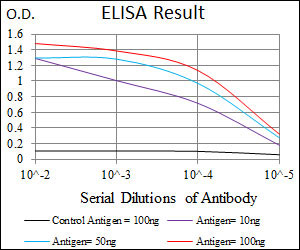
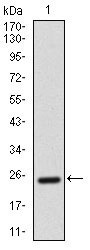
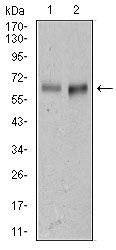
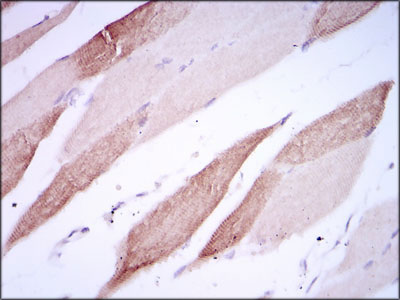
- 产品详情
- 实验流程
Application 
| WB, IHC, E |
|---|---|
| Primary Accession | Q13740 |
| Reactivity | Human |
| Host | Mouse |
| Clonality | Monoclonal |
| Clone Names | 5B3 |
| Isotype | IgG1 |
| Calculated MW | 65102 Da |
| Description | This gene encodes activated leukocyte cell adhesion molecule (ALCAM), also known as CD166 (cluster of differentiation 166), which is a member of a subfamily of immunoglobulin receptors with five immunoglobulin-like domains (VVC2C2C2) in the extracellular domain. This protein binds to T-cell differentiation antigene CD6, and is implicated in the processes of cell adhesion and migration. Multiple alternatively spliced transcript variants encoding different isoforms have been found. |
| Immunogen | Purified recombinant fragment of human AlCAM (AA: 405-524) expressed in E. Coli. |
| Formulation | Purified antibody in PBS with 0.05% sodium azide |
| Gene ID | 214 |
|---|---|
| Other Names | CD166 antigen, Activated leukocyte cell adhesion molecule, CD166, ALCAM, MEMD |
| Dilution | WB~~1/500 - 1/2000 IHC~~1/200 - 1/1000 E~~1/10000 |
| Storage | Maintain refrigerated at 2-8°C for up to 6 months. For long term storage store at -20°C in small aliquots to prevent freeze-thaw cycles. |
| Precautions | AlCAM Antibody is for research use only and not for use in diagnostic or therapeutic procedures. |
For Research Use Only. Not For Use In Diagnostic Procedures.
| Name | ALCAM |
|---|---|
| Synonyms | MEMD {ECO:0000303|PubMed:9502422} |
| Function | Cell adhesion molecule that mediates both heterotypic cell- cell contacts via its interaction with CD6, as well as homotypic cell- cell contacts (PubMed:15048703, PubMed:15496415, PubMed:16352806, PubMed:23169771, PubMed:24945728, PubMed:7760007). Promotes T-cell activation and proliferation via its interactions with CD6 (PubMed:15048703, PubMed:16352806, PubMed:24945728). Contributes to the formation and maturation of the immunological synapse via its interactions with CD6 (PubMed:15294938, PubMed:16352806). Mediates homotypic interactions with cells that express ALCAM (PubMed:15496415, PubMed:16352806). Acts as a ligand for the LILRB4 receptor, enhancing LILRB4-mediated inhibition of T cell proliferation (PubMed:29263213). Required for normal hematopoietic stem cell engraftment in the bone marrow (PubMed:24740813). Mediates attachment of dendritic cells onto endothelial cells via homotypic interaction (PubMed:23169771). Inhibits endothelial cell migration and promotes endothelial tube formation via homotypic interactions (PubMed:15496415, PubMed:23169771). Required for normal organization of the lymph vessel network. Required for normal hematopoietic stem cell engraftment in the bone marrow. Plays a role in hematopoiesis; required for normal numbers of hematopoietic stem cells in bone marrow. Promotes in vitro osteoblast proliferation and differentiation (By similarity). Promotes neurite extension, axon growth and axon guidance; axons grow preferentially on surfaces that contain ALCAM. Mediates outgrowth and pathfinding for retinal ganglion cell axons (By similarity). |
| Cellular Location | Cell membrane; Single-pass type I membrane protein. Cell projection, axon {ECO:0000250|UniProtKB:Q61490}. Cell projection, dendrite {ECO:0000250|UniProtKB:Q61490}. Note=Detected at the immunological synapse, i.e, at the contact zone between antigen-presenting dendritic cells and T-cells (PubMed:15294938, PubMed:16352806). Colocalizes with CD6 and the TCR/CD3 complex at the immunological synapse (PubMed:15294938). |
| Tissue Location | Detected on hematopoietic stem cells derived from umbilical cord blood (PubMed:24740813). Detected on lymph vessel endothelial cells, skin and tonsil (PubMed:23169771). Detected on peripheral blood monocytes (PubMed:15048703). Detected on monocyte- derived dendritic cells (at protein level) (PubMed:16352806). Detected at low levels in spleen, placenta, liver (PubMed:9502422). Expressed by activated T-cells, B-cells, monocytes and thymic epithelial cells (PubMed:7760007). Isoform 1 and isoform 3 are detected in vein and artery endothelial cells, astrocytes, keratinocytes and artery smooth muscle cells (PubMed:15496415). Expressed by neurons in the brain Restricted expression in tumor cell lines. Detected in highly metastasizing melanoma cell lines (PubMed:9502422) |
Research Areas
Application Protocols
Provided below are standard protocols that you may find useful for product applications.
REFERENCES
1.Vascul Pharmacol. 2011 Mar-Jun;54(3-6):93-9.2.Int J Gynecol Cancer. 2011 Apr;21(3):523-8.

终于等到您。ABCEPTA(百远生物)抗体产品。
点击下方“我要评价 ”按钮提交您的反馈信息,您的反馈和评价是我们最宝贵的财富之一,
我们将在1-3个工作日内处理您的反馈信息。
如有疑问,联系:0512-88856768 tech-china@abcepta.com.
¥ 1,250.00
Cat# AO1748a


