


 癌症的基本特征包括细胞增殖、血管生成、迁移、凋亡逃避机制和细胞永生等。找到癌症发生过程中这些通路的关键标记物和对应的抗体用于检测至关重要。
 为您推荐一个泛素化位点预测神器——泛素化分析工具,可以为您的蛋白的泛素化位点作出预测和评分。
 细胞自噬受体图形绘图工具为你的蛋白的细胞受体结合位点作出预测和评分,识别结合到自噬通路中的蛋白是非常重要的,便于让我们理解自噬在正常生理、病理过程中的作用,如发育、细胞分化、神经退化性疾病、压力条件下、感染和癌症。
STX11 Antibody(N-term) 精选
Affinity Purified Rabbit Polyclonal Antibody (Pab)
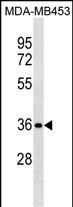
- 产品详情
- 实验流程
- 背景知识
Application 
| WB, E |
|---|---|
| Primary Accession | O75558 |
| Other Accession | NP_003755.2 |
| Reactivity | Human |
| Predicted | Rabbit |
| Host | Rabbit |
| Clonality | Polyclonal |
| Isotype | Rabbit IgG |
| Calculated MW | 33196 Da |
| Antigen Region | 29-56 aa |
| Gene ID | 8676 |
|---|---|
| Other Names | Syntaxin-11, STX11 |
| Target/Specificity | This STX11 antibody is generated from rabbits immunized with a KLH conjugated synthetic peptide between 29-56 amino acids from the N-terminal region of human STX11. |
| Dilution | WB~~1:1000 E~~Use at an assay dependent concentration. |
| Format | Purified polyclonal antibody supplied in PBS with 0.09% (W/V) sodium azide. This antibody is purified through a protein A column, followed by peptide affinity purification. |
| Storage | Maintain refrigerated at 2-8°C for up to 2 weeks. For long term storage store at -20°C in small aliquots to prevent freeze-thaw cycles. |
| Precautions | STX11 Antibody(N-term) is for research use only and not for use in diagnostic or therapeutic procedures. |
For Research Use Only. Not For Use In Diagnostic Procedures.
| Name | STX11 (HGNC:11429) |
|---|---|
| Function | SNAREs (soluble N-ethylmaleimide-sensitive factor-attachment protein receptors) are essential proteins for intracellular membrane fusion. SNAREs localized on opposing membranes assemble to form a trans-SNARE complex, an extended, parallel four-helix bundle whose assembly releases energy that drives membrane fusion. The core SNARE complex typically consists of four alpha-helical domains, three from target membrane SNAREs (t-SNAREs) and one from a vesicle SNARE (v- SNARE) (PubMed:10036234, PubMed:24227526, PubMed:26771955, PubMed:28265073). Syntaxin-11/STX11 is an atypical lipid-anchored t- SNARE that forms a SNARE complex with the t-SNARE SNAP23 and the v- SNARE VAMP8. This SNARE complex plays a critical role in the regulated exocytosis of cytotoxic granules by natural killer (NK) cells and cytotoxic T-lymphocytes (PubMed:17525286, PubMed:19804848, PubMed:19884660, PubMed:24227526, PubMed:26771955, PubMed:28265073). In macrophages, STX11 regulates stimulus-dependent vesicular transport of TLR4 from recycling endosomes to the plasma membrane by cooperating with SNAP23, thereby playing a critical role in microbial component recognition and the induction of innate and adaptive immunity (By similarity). In skeletal muscle satellite cells, STX11 cooperates with its cognate SNAREs VAMP4 and SNAP23 to facilitate CD36 vesicular transport from endosomes to the plasma membrane, an essential step in muscle regeneration (By similarity). In another proposed mechanism, STX11 may function as a regulator of the SNARE VTI1B on late endosomes to regulate trafficking from late endosomes to lysosomes (PubMed:21388490). |
| Cellular Location | Cell membrane; Lipid-anchor. Late endosome membrane. Note=Palmitoylation participates to membrane anchorage (PubMed:10036234, PubMed:15703195, PubMed:24910990) Localizes at the immunological synapse in activated immune cells (PubMed:24910990, PubMed:26771955). Detected in trans-Golgi network, recycling and late endosomes when overexpressed (PubMed:10036234, PubMed:21388490). |
| Tissue Location | Broadly expressed. Abundantly expressed in heart, lung and placenta. Expressed in macrophages. Expressed in cytotoxic lymphocytes (at protein level). |
Provided below are standard protocols that you may find useful for product applications.
BACKGROUND
This gene encodes a member of the syntaxin family. Syntaxins have been implicated in the targeting and fusion of intracellular transport vesicles. This family member may regulate protein transport among late endosomes and the trans-Golgi network. Mutations in this gene have been associated with familial hemophagocytic lymphohistiocytosis.
REFERENCES
Marsh, R.A., et al. Pediatr Blood Cancer 55(1):134-140(2010)
Rose, J.E., et al. Mol. Med. 16 (7-8), 247-253 (2010) :
Danielian, S., et al. J. Clin. Immunol. 30(2):330-337(2010)
zur Stadt, U., et al. Am. J. Hum. Genet. 85(4):482-492(2009)
Marcelin, G., et al. Mamm. Genome 20(3):131-139(2009)

终于等到您。ABCEPTA(百远生物)抗体产品。
点击下方“我要评价 ”按钮提交您的反馈信息,您的反馈和评价是我们最宝贵的财富之一,
我们将在1-3个工作日内处理您的反馈信息。
如有疑问,联系:0512-88856768 tech-china@abcepta.com.


