


 癌症的基本特征包括细胞增殖、血管生成、迁移、凋亡逃避机制和细胞永生等。找到癌症发生过程中这些通路的关键标记物和对应的抗体用于检测至关重要。
 为您推荐一个泛素化位点预测神器——泛素化分析工具,可以为您的蛋白的泛素化位点作出预测和评分。
 细胞自噬受体图形绘图工具为你的蛋白的细胞受体结合位点作出预测和评分,识别结合到自噬通路中的蛋白是非常重要的,便于让我们理解自噬在正常生理、病理过程中的作用,如发育、细胞分化、神经退化性疾病、压力条件下、感染和癌症。
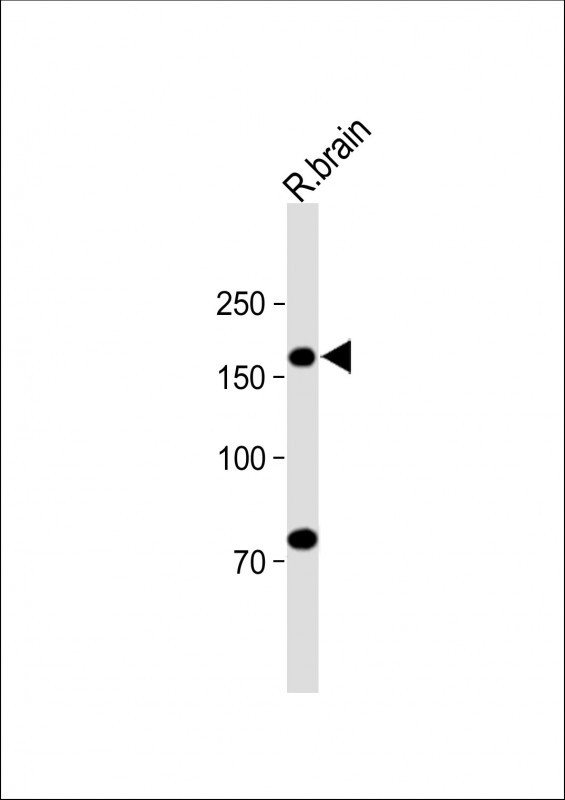
RAPGEF2 Antibody (C-term) 精选
Purified Rabbit Polyclonal Antibody (Pab)
- 产品详情
- 实验流程
- 背景知识
Application 
| WB, E |
|---|---|
| Primary Accession | Q9Y4G8 |
| Reactivity | Human |
| Predicted | Canine, Rabbit, Chicken |
| Host | Rabbit |
| Clonality | polyclonal |
| Isotype | Rabbit IgG |
| Calculated MW | 167417 Da |
| Gene ID | 9693 |
|---|---|
| Other Names | Rap guanine nucleotide exchange factor 2, Cyclic nucleotide ras GEF, CNrasGEF, Neural RAP guanine nucleotide exchange protein, nRap GEP, PDZ domain-containing guanine nucleotide exchange factor 1, PDZ-GEF1, RA-GEF-1, Ras/Rap1-associating GEF-1, RAPGEF2, KIAA0313, NRAPGEP, PDZGEF1 |
| Target/Specificity | This RAPGEF2 antibody is generated from a rabbit immunized with a KLH conjugated synthetic peptide between 1464-1498 amino acids from the C-terminal region of human RAPGEF2. |
| Dilution | WB~~1:500 E~~Use at an assay dependent concentration. |
| Format | Purified polyclonal antibody supplied in PBS with 0.05% (V/V) Proclin 300. This antibody is purified through a protein A column, followed by peptide affinity purification. |
| Storage | Maintain refrigerated at 2-8°C for up to 2 weeks. For long term storage store at -20°C in small aliquots to prevent freeze-thaw cycles. |
| Precautions | RAPGEF2 Antibody (C-term) is for research use only and not for use in diagnostic or therapeutic procedures. |
For Research Use Only. Not For Use In Diagnostic Procedures.
| Name | RAPGEF2 |
|---|---|
| Synonyms | KIAA0313, NRAPGEP, PDZGEF1 |
| Function | Functions as a guanine nucleotide exchange factor (GEF), which activates Rap and Ras family of small GTPases by exchanging bound GDP for free GTP in a cAMP-dependent manner. Serves as a link between cell surface receptors and Rap/Ras GTPases in intracellular signaling cascades. Also acts as an effector for Rap1 by direct association with Rap1-GTP thereby leading to the amplification of Rap1-mediated signaling. Shows weak activity on HRAS. It is controversial whether RAPGEF2 binds cAMP and cGMP (PubMed:23800469, PubMed:10801446) or not (PubMed:10548487, PubMed:10608844, PubMed:11359771). Its binding to ligand-activated beta-1 adrenergic receptor ADRB1 leads to the Ras activation through the G(s)-alpha signaling pathway. Involved in the cAMP-induced Ras and Erk1/2 signaling pathway that leads to sustained inhibition of long term melanogenesis by reducing dendrite extension and melanin synthesis. Also provides inhibitory signals for cell proliferation of melanoma cells and promotes their apoptosis in a cAMP- independent nanner. Regulates cAMP-induced neuritogenesis by mediating the Rap1/B-Raf/ERK signaling through a pathway that is independent on both PKA and RAPGEF3/RAPGEF4. Involved in neuron migration and in the formation of the major forebrain fiber connections forming the corpus callosum, the anterior commissure and the hippocampal commissure during brain development. Involved in neuronal growth factor (NGF)-induced sustained activation of Rap1 at late endosomes and in brain-derived neurotrophic factor (BDNF)-induced axon outgrowth of hippocampal neurons. Plays a role in the regulation of embryonic blood vessel formation and in the establishment of basal junction integrity and endothelial barrier function. May be involved in the regulation of the vascular endothelial growth factor receptor KDR and cadherin CDH5 expression at allantois endothelial cell-cell junctions. |
| Cellular Location | Cytoplasm. Cytoplasm, perinuclear region. Cell membrane. Late endosome. Cell junction. Note=Associated with the synaptic plasma membrane. Colocalizes with ADRB1 at the plasma membrane. Synaptosome. Enriched in synaptic plasma membrane and neuronal cell body. Colocalized with CTNNB1 at cell-cell contacts (By similarity). Localized diffusely in the cytoplasm before neuronal growth factor (NGF) stimulation. Recruited to late endosomes after NGF stimulation. Colocalized with the high affinity nerve growth factor receptor NTRK1 at late endosomes. Translocated to the perinuclear region in a RAP1A-dependent manner. Translocated to the cell membrane |
| Tissue Location | Expressed in primary neuronal and endocrine cells (at protein level). Highest expression levels in brain. Lower expression levels in heart, kidney, lung, placenta and blood leukocytes. |
Provided below are standard protocols that you may find useful for product applications.
BACKGROUND
Functions as a guanine nucleotide exchange factor (GEF), which activates Rap and Ras family of small GTPases by exchanging bound GDP for free GTP in a cAMP-dependent manner. Serves as a link between cell surface receptors and Rap/Ras GTPases in intracellular signaling cascades. Acts also as an effector for Rap1 by direct association with Rap1-GTP thereby leading to the amplification of Rap1-mediated signaling. Shows weak activity on HRAS. It is controversial whether RAPGEF2 binds cAMP and cGMP (PubMed:23800469, PubMed:10801446) or not (PubMed:10608844, PubMed:10548487, PubMed:11359771). Its binding to ligand-activated beta-1 adrenergic receptor ADRB1 leads to the Ras activation through the G(s)-alpha signaling pathway. Involved in the cAMP- induced Ras and Erk1/2 signaling pathway that leads to sustained inhibition of long term melanogenesis by reducing dendrite extension and melanin synthesis. Provides also inhibitory signals for cell proliferation of melanoma cells and promotes their apoptosis in a cAMP-independent nanner. Regulates cAMP-induced neuritogenesis by mediating the Rap1/B-Raf/ERK signaling through a pathway that is independent on both PKA and RAPGEF3/RAPGEF4. Involved in neuron migration and in the formation of the major forebrain fiber connections forming the corpus callosum, the anterior commissure and the hippocampal commissure during brain development. Involved in neuronal growth factor (NGF)-induced sustained activation of Rap1 at late endosomes and in brain- derived neurotrophic factor (BDNF)-induced axon outgrowth of hippocampal neurons. Plays a role in the regulation of embryonic blood vessel formation and in the establishment of basal junction integrity and endothelial barrier function. May be involved in the regulation of the vascular endothelial growth factor receptor KDR and cadherin CDH5 expression at allantois endothelial cell-cell junctions.
REFERENCES
Nagase T.,et al.DNA Res. 4:141-150(1997).
Mural R.J.,et al.Submitted (SEP-2005) to the EMBL/GenBank/DDBJ databases.
Ohtsuka T.,et al.Biochem. Biophys. Res. Commun. 265:38-44(1999).
Liao Y.,et al.J. Biol. Chem. 274:37815-37820(1999).
de Rooij J.,et al.J. Biol. Chem. 274:38125-38130(1999).

终于等到您。ABCEPTA(百远生物)抗体产品。
点击下方“我要评价 ”按钮提交您的反馈信息,您的反馈和评价是我们最宝贵的财富之一,
我们将在1-3个工作日内处理您的反馈信息。
如有疑问,联系:0512-88856768 tech-china@abcepta.com.


