


 癌症的基本特征包括细胞增殖、血管生成、迁移、凋亡逃避机制和细胞永生等。找到癌症发生过程中这些通路的关键标记物和对应的抗体用于检测至关重要。
 为您推荐一个泛素化位点预测神器——泛素化分析工具,可以为您的蛋白的泛素化位点作出预测和评分。
 细胞自噬受体图形绘图工具为你的蛋白的细胞受体结合位点作出预测和评分,识别结合到自噬通路中的蛋白是非常重要的,便于让我们理解自噬在正常生理、病理过程中的作用,如发育、细胞分化、神经退化性疾病、压力条件下、感染和癌症。
GBA2 Antibody (Center) 精选
Purified Rabbit Polyclonal Antibody (Pab)
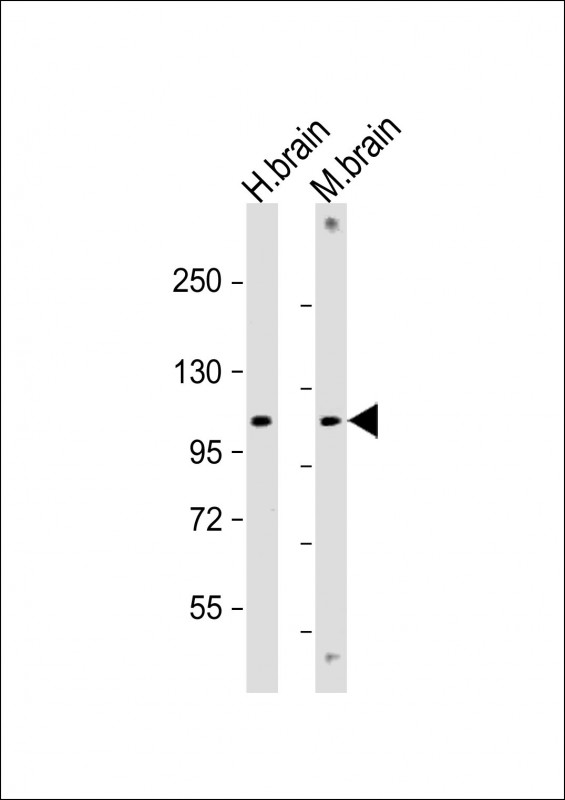
- 产品详情
- 实验流程
- 背景知识
Application 
| WB, E |
|---|---|
| Primary Accession | Q9HCG7 |
| Other Accession | Q69ZF3, Q5M868 |
| Reactivity | Human, Rat, Mouse |
| Predicted | Rat, Bovine, Canine, Rabbit, Chicken |
| Host | Rabbit |
| Clonality | polyclonal |
| Isotype | Rabbit IgG |
| Calculated MW | 104649 Da |
| Gene ID | 57704 |
|---|---|
| Other Names | Non-lysosomal glucosylceramidase, NLGase, 3.2.1.45, Beta-glucocerebrosidase 2, Beta-glucosidase 2, Glucosylceramidase 2, GBA2, KIAA1605 |
| Target/Specificity | This GBA2 antibody is generated from a rabbit immunized with a KLH conjugated synthetic peptide between 593-623 amino acids from the Central region of human GBA2. |
| Dilution | WB~~1:2000 E~~Use at an assay dependent concentration. |
| Format | Purified polyclonal antibody supplied in PBS with 0.09% (W/V) sodium azide. This antibody is purified through a protein A column, followed by peptide affinity purification. |
| Storage | Maintain refrigerated at 2-8°C for up to 2 weeks. For long term storage store at -20°C in small aliquots to prevent freeze-thaw cycles. |
| Precautions | GBA2 Antibody (Center) is for research use only and not for use in diagnostic or therapeutic procedures. |
For Research Use Only. Not For Use In Diagnostic Procedures.
| Name | GBA2 (HGNC:18986) |
|---|---|
| Function | Non-lysosomal glucosylceramidase that catalyzes the hydrolysis of glucosylceramides/GlcCers (such as beta-D-glucosyl- (1<->1')-N-acylsphing-4-enine) to free glucose and ceramides (such as N-acylsphing-4-enine) (PubMed:17105727, PubMed:30308956, PubMed:32144204). GlcCers are membrane glycosphingolipids that have a wide intracellular distribution (By similarity). They are the main precursors of more complex glycosphingolipids that play a role in cellular growth, differentiation, adhesion, signaling, cytoskeletal dynamics and membrane properties (By similarity). Involved in the transglucosylation of cholesterol, transfers glucose from GlcCer to cholesterol, thereby modifying its water solubility and biological properties (PubMed:32144204). Under specific conditions, may catalyze the reverse reaction, transferring glucose from cholesteryl-3-beta-D- glucoside to ceramide (such as N-acylsphing-4-enine) (Probable). May play a role in the metabolism of bile acids (PubMed:11489889, PubMed:17080196, PubMed:9111029). Able to hydrolyze bile acid 3-O- glucosides as well as to produce bile acid-glucose conjugates thanks to a bile acid glucosyl transferase activity (PubMed:11489889, PubMed:17080196, PubMed:9111029). Catalyzes the hydrolysis of galactosylceramides/GalCers (such as beta-D-galactosyl-(1<->1')-N- acylsphing-4-enine), as well as the galactosyl transfer between GalCers and cholesterol in vitro with lower activity compared with their activity against GlcCers (PubMed:32144204). |
| Cellular Location | Endoplasmic reticulum membrane {ECO:0000250|UniProtKB:Q69ZF3}; Peripheral membrane protein; Cytoplasmic side {ECO:0000250|UniProtKB:Q69ZF3}. Golgi apparatus membrane {ECO:0000250|UniProtKB:Q69ZF3}; Peripheral membrane protein; Cytoplasmic side {ECO:0000250|UniProtKB:Q69ZF3}. Note=Localization to the plasma membrane and alternative topologies have also been reported |
| Tissue Location | Widely expressed (PubMed:11489889). Mainly expressed in brain, heart, skeletal muscle, kidney and placenta and expressed at lower levels in liver, spleen, small intestine and lung (PubMed:11489889). Detectable in colon, thymus and peripheral blood leukocytes (PubMed:11489889). |
Provided below are standard protocols that you may find useful for product applications.
BACKGROUND
Non-lysosomal glucosylceramidase that catalyzes the conversion of glucosylceramide (GlcCer) to free glucose and ceramide. Involved in sphingomyelin generation and prevention of glycolipid accumulation. May also catalyze the hydrolysis of bile acid 3-O-glucosides, however, the relevance of such activity is unclear in vivo. Plays a role in central nevous system development. Required for proper formation of motor neuron axons.
REFERENCES
Matern H.,et al.J. Biol. Chem. 276:37929-37933(2001).
Nagase T.,et al.DNA Res. 7:273-281(2000).
Ota T.,et al.Nat. Genet. 36:40-45(2004).
Bechtel S.,et al.BMC Genomics 8:399-399(2007).
Humphray S.J.,et al.Nature 429:369-374(2004).

终于等到您。ABCEPTA(百远生物)抗体产品。
点击下方“我要评价 ”按钮提交您的反馈信息,您的反馈和评价是我们最宝贵的财富之一,
我们将在1-3个工作日内处理您的反馈信息。
如有疑问,联系:0512-88856768 tech-china@abcepta.com.


