


 癌症的基本特征包括细胞增殖、血管生成、迁移、凋亡逃避机制和细胞永生等。找到癌症发生过程中这些通路的关键标记物和对应的抗体用于检测至关重要。
 为您推荐一个泛素化位点预测神器——泛素化分析工具,可以为您的蛋白的泛素化位点作出预测和评分。
 细胞自噬受体图形绘图工具为你的蛋白的细胞受体结合位点作出预测和评分,识别结合到自噬通路中的蛋白是非常重要的,便于让我们理解自噬在正常生理、病理过程中的作用,如发育、细胞分化、神经退化性疾病、压力条件下、感染和癌症。
Anti-EIF5A Antibody
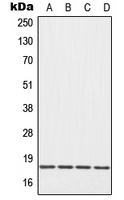
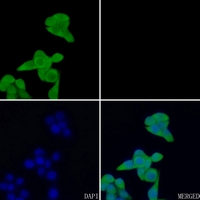
- 产品详情
- 实验流程
Application 
| WB, IF/IC |
|---|---|
| Primary Accession | P63241 |
| Reactivity | Human, Mouse, Rat, Rabbit, Bovine, Sheep |
| Host | Rabbit |
| Clonality | Polyclonal |
| Calculated MW | 16832 Da |
| Gene ID | 1984 |
|---|---|
| Other Names | Eukaryotic translation initiation factor 5A-1; eIF-5A-1; eIF-5A1; Eukaryotic initiation factor 5A isoform 1; eIF-5A; Rev-binding factor; eIF-4D |
| Target/Specificity | KLH-conjugated synthetic peptide encompassing a sequence within the center region of human EIF5A. The exact sequence is proprietary. |
| Dilution | WB~~WB (1/500 - 1/1000) IF/IC~~N/A |
| Format | Liquid in 0.42% Potassium phosphate, 0.87% Sodium chloride, pH 7.3, 30% glycerol, and 0.01% sodium azide. |
| Storage | Store at -20 °C.Stable for 12 months from date of receipt |
For Research Use Only. Not For Use In Diagnostic Procedures.
| Name | EIF5A (HGNC:3300) |
|---|---|
| Function | Translation factor that promotes translation elongation and termination, particularly upon ribosome stalling at specific amino acid sequence contexts (PubMed:33547280). Binds between the exit (E) and peptidyl (P) site of the ribosome and promotes rescue of stalled ribosome: specifically required for efficient translation of polyproline-containing peptides as well as other motifs that stall the ribosome (By similarity). Acts as a ribosome quality control (RQC) cofactor by joining the RQC complex to facilitate peptidyl transfer during CAT tailing step (By similarity). Also involved in actin dynamics and cell cycle progression, mRNA decay and probably in a pathway involved in stress response and maintenance of cell wall integrity (PubMed:16987817). With syntenin SDCBP, functions as a regulator of p53/TP53 and p53/TP53-dependent apoptosis (PubMed:15371445). Also regulates TNF-mediated apoptosis (PubMed:15452064, PubMed:17187778). Mediates effects of polyamines on neuronal process extension and survival (PubMed:17360499). Is required for autophagy by assisting the ribosome in translating the ATG3 protein at a specific amino acid sequence, the 'ASP-ASP-Gly' motif, leading to the increase of the efficiency of ATG3 translation and facilitation of LC3B lipidation and autophagosome formation (PubMed:29712776). |
| Cellular Location | Cytoplasm. Nucleus. Endoplasmic reticulum membrane; Peripheral membrane protein; Cytoplasmic side. Note=Hypusine modification promotes the nuclear export and cytoplasmic localization and there was a dynamic shift in the localization from predominantly cytoplasmic to primarily nuclear under apoptotic inducing conditions (PubMed:19379712, PubMed:27306458). Nuclear export of hypusinated protein is mediated by XPO4 (PubMed:10944119, PubMed:27306458). |
| Tissue Location | Expressed in umbilical vein endothelial cells and several cancer cell lines (at protein level) |
Research Areas
Application Protocols
Provided below are standard protocols that you may find useful for product applications.
REFERENCES
Smit-Mcbride Z.,et al.J. Biol. Chem. 264:1578-1583(1989).
Ruhl M.,et al.J. Cell Biol. 123:1309-1320(1993).
Koettnitz K.,et al.Gene 144:249-252(1994).
Koettnitz K.,et al.Gene 159:283-284(1995).
Johansson H.E.,et al.Submitted (JUL-2002) to the EMBL/GenBank/DDBJ databases.

终于等到您。ABCEPTA(百远生物)抗体产品。
点击下方“我要评价 ”按钮提交您的反馈信息,您的反馈和评价是我们最宝贵的财富之一,
我们将在1-3个工作日内处理您的反馈信息。
如有疑问,联系:0512-88856768 tech-china@abcepta.com.
¥ 1,250.00
Cat# AP52004


