


 癌症的基本特征包括细胞增殖、血管生成、迁移、凋亡逃避机制和细胞永生等。找到癌症发生过程中这些通路的关键标记物和对应的抗体用于检测至关重要。
 为您推荐一个泛素化位点预测神器——泛素化分析工具,可以为您的蛋白的泛素化位点作出预测和评分。
 细胞自噬受体图形绘图工具为你的蛋白的细胞受体结合位点作出预测和评分,识别结合到自噬通路中的蛋白是非常重要的,便于让我们理解自噬在正常生理、病理过程中的作用,如发育、细胞分化、神经退化性疾病、压力条件下、感染和癌症。
Spastin Rabbit pAb
Spastin Rabbit pAb
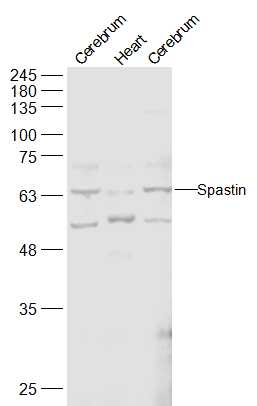
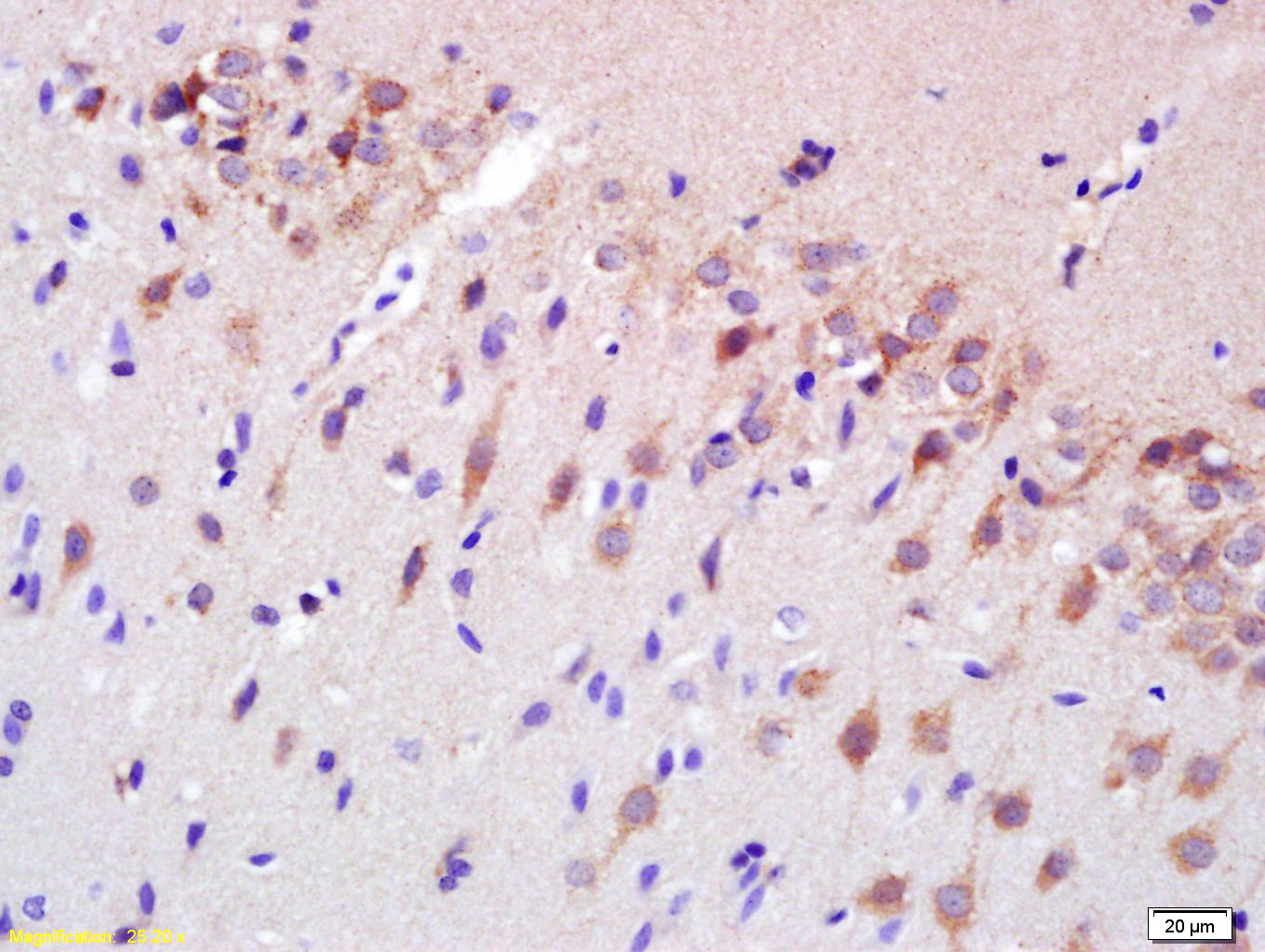
- 产品详情
- 实验流程
- 背景知识
Application 
| WB, IHC-P, IHC-F, IF |
|---|---|
| Primary Accession | Q9UBP0 |
| Reactivity | Rat, Human, Mouse |
| Predicted | Pig, Dog, Rabbit, Chicken, Horse |
| Host | Rabbit |
| Clonality | Polyclonal |
| Calculated MW | 67197 Da |
| Physical State | Liquid |
| Immunogen | KLH conjugated synthetic peptide derived from human FSP |
| Epitope Specificity | 551-616/616 |
| Isotype | IgG |
| Purity | affinity purified by Protein A |
| Buffer | 0.01M TBS (pH7.4) with 1% BSA, 0.02% Proclin300 and 50% Glycerol. |
| SUBCELLULAR LOCATION | Membrane; Single-pass membrane protein (Potential). Cytoplasm, cytoskeleton, centrosome. Cytoplasm, cytoskeleton. Cytoplasm, perinuclear region. Endoplasmic reticulum. Endosome. Nucleus. Cytoplasm, cytoskeleton, spindle. Note=Localization to the centrosome is independent of microtubules. Localizes to the midbody of dividing cells, and this requires CHMP1B. Enriched in the distal axons and branches of postmitotic neurons. Isoform 3 is the main endosomal form. |
| Important Note | This product as supplied is intended for research use only, not for use in human, therapeutic or diagnostic applications. |
| Background Descriptions | This gene encodes a member of the AAA (ATPases associated with a variety of cellular activities) protein family. Members of this protein family share an ATPase domain and have roles in diverse cellular processes including membrane trafficking, intracellular motility, organelle biogenesis, protein folding, and proteolysis. The encoded ATPase may be involved in the assembly or function of nuclear protein complexes. Two transcript variants encoding distinct isoforms have been identified for this gene. Other alternative splice variants have been described but their full length sequences have not been determined. Mutations associated with this gene cause the most frequent form of autosomal dominant spastic paraplegia 4. [provided by RefSeq, Jul 2008] |
| Gene ID | 6683 |
|---|---|
| Other Names | Spastin {ECO:0000255|HAMAP-Rule:MF_03021, ECO:0000303|PubMed:10610178}, 5.6.1.1 {ECO:0000255|HAMAP-Rule:MF_03021, ECO:0000269|PubMed:15716377, ECO:0000269|PubMed:16219033, ECO:0000269|PubMed:16815977, ECO:0000269|PubMed:17389232, ECO:0000269|PubMed:18410514, ECO:0000269|PubMed:22637577}, Spastic paraplegia 4 protein, SPAST {ECO:0000255|HAMAP-Rule:MF_03021, ECO:0000312|HGNC:HGNC:11233} |
| Dilution | WB=1:500-2000,IHC-P=1:100-500,IHC-F=1:100-500,IF=1:100-500 |
| Storage | Store at -20 °C for one year. Avoid repeated freeze/thaw cycles. When reconstituted in sterile pH 7.4 0.01M PBS or diluent of antibody the antibody is stable for at least two weeks at 2-4 °C. |
For Research Use Only. Not For Use In Diagnostic Procedures.
| Name | SPAST {ECO:0000255|HAMAP-Rule:MF_03021, ECO:0000312|HGNC:HGNC:11233} |
|---|---|
| Function | ATP-dependent microtubule severing protein that specifically recognizes and cuts microtubules that are polyglutamylated (PubMed:11809724, PubMed:15716377, PubMed:16219033, PubMed:17389232, PubMed:20530212, PubMed:22637577, PubMed:26875866). Preferentially recognizes and acts on microtubules decorated with short polyglutamate tails: severing activity increases as the number of glutamates per tubulin rises from one to eight, but decreases beyond this glutamylation threshold (PubMed:26875866). Severing activity is not dependent on tubulin acetylation or detyrosination (PubMed:26875866). Microtubule severing promotes reorganization of cellular microtubule arrays and the release of microtubules from the centrosome following nucleation. It is critical for the biogenesis and maintenance of complex microtubule arrays in axons, spindles and cilia. SPAST is involved in abscission step of cytokinesis and nuclear envelope reassembly during anaphase in cooperation with the ESCRT-III complex (PubMed:19000169, PubMed:21310966, PubMed:26040712). Recruited at the midbody, probably by IST1, and participates in membrane fission during abscission together with the ESCRT-III complex (PubMed:21310966). Recruited to the nuclear membrane by IST1 and mediates microtubule severing, promoting nuclear envelope sealing and mitotic spindle disassembly during late anaphase (PubMed:26040712). Required for membrane traffic from the endoplasmic reticulum (ER) to the Golgi and endosome recycling (PubMed:23897888). Recruited by IST1 to endosomes and regulates early endosomal tubulation and recycling by mediating microtubule severing (PubMed:23897888). Probably plays a role in axon growth and the formation of axonal branches (PubMed:15716377). |
| Cellular Location | Membrane {ECO:0000255|HAMAP-Rule:MF_03021, ECO:0000269|PubMed:19000169}; Peripheral membrane protein {ECO:0000255|HAMAP-Rule:MF_03021, ECO:0000305|PubMed:20200447} Endoplasmic reticulum {ECO:0000255|HAMAP-Rule:MF_03021, ECO:0000269|PubMed:16602018}. Midbody {ECO:0000255|HAMAP-Rule:MF_03021, ECO:0000269|PubMed:18997780, ECO:0000269|PubMed:21310966, ECO:0000269|PubMed:25390646}. Cytoplasm, cytoskeleton, microtubule organizing center, centrosome {ECO:0000255|HAMAP-Rule:MF_03021, ECO:0000269|PubMed:15269182, ECO:0000269|PubMed:15891913, ECO:0000269|PubMed:25390646}. Cytoplasm, cytoskeleton {ECO:0000255|HAMAP-Rule:MF_03021, ECO:0000269|PubMed:15716377, ECO:0000269|PubMed:17389232, ECO:0000269|PubMed:18410514, ECO:0000269|PubMed:19000169, ECO:0000269|PubMed:20200447}. Cytoplasm, perinuclear region {ECO:0000255|HAMAP-Rule:MF_03021, ECO:0000269|PubMed:11809724, ECO:0000269|PubMed:15147984, ECO:0000269|PubMed:15269182, ECO:0000269|PubMed:15537668}. Nucleus {ECO:0000255|HAMAP-Rule:MF_03021, ECO:0000269|PubMed:15147984, ECO:0000269|PubMed:15269182, ECO:0000269|PubMed:16026783}. Cytoplasm, cytoskeleton, spindle {ECO:0000255|HAMAP-Rule:MF_03021, ECO:0000269|PubMed:15269182}. Cytoplasm {ECO:0000255|HAMAP- Rule:MF_03021, ECO:0000269|PubMed:16026783, ECO:0000269|PubMed:20200447}. Cell projection, axon. Note=Forms an intramembrane hairpin-like structure in the membrane (PubMed:20200447). Localization to the centrosome is independent of microtubules (PubMed:15891913). Localizes to the midbody of dividing cells, and this requires CHMP1B (PubMed:18997780). Enriched in the distal axons and branches of postmitotic neurons (PubMed:15269182). Mainly nuclear in interphase cells and becomes associated with the centrosomes, spindle microtubules, midzone and finally the midbody during cell division (PubMed:15269182). {ECO:0000255|HAMAP-Rule:MF_03021, ECO:0000269|PubMed:15269182, ECO:0000269|PubMed:15891913, ECO:0000269|PubMed:18997780, ECO:0000305|PubMed:20200447} [Isoform 3]: Cytoplasm. Endosome. Nucleus membrane Cytoplasm, cytoskeleton, microtubule organizing center, centrosome. Note=Constitutes the main endosomal form (PubMed:19000169). Recruited to nuclear membrane by IST1 during late anaphase (PubMed:26040712). |
| Tissue Location | Expressed in brain, heart, kidney, liver, lung, pancreas, placenta and skeletal muscle. The short isoforms may predominate in brain and spinal cord. |
Provided below are standard protocols that you may find useful for product applications.
BACKGROUND
This product as supplied is intended for research use only, not for use in human, therapeutic or diagnostic applications.
REFERENCES
Hazan J.,et al.Nat. Genet. 23:296-303(1999).
Kikuno R.,et al.DNA Res. 6:197-205(1999).
Mural R.J.,et al.Submitted (SEP-2005) to the EMBL/GenBank/DDBJ databases.
Errico A.,et al.Hum. Mol. Genet. 11:153-163(2002).
Ciccarelli F.D.,et al.Genomics 81:437-441(2003).

终于等到您。ABCEPTA(百远生物)抗体产品。
点击下方“我要评价 ”按钮提交您的反馈信息,您的反馈和评价是我们最宝贵的财富之一,
我们将在1-3个工作日内处理您的反馈信息。
如有疑问,联系:0512-88856768 tech-china@abcepta.com.


