


 癌症的基本特征包括细胞增殖、血管生成、迁移、凋亡逃避机制和细胞永生等。找到癌症发生过程中这些通路的关键标记物和对应的抗体用于检测至关重要。
 为您推荐一个泛素化位点预测神器——泛素化分析工具,可以为您的蛋白的泛素化位点作出预测和评分。
 细胞自噬受体图形绘图工具为你的蛋白的细胞受体结合位点作出预测和评分,识别结合到自噬通路中的蛋白是非常重要的,便于让我们理解自噬在正常生理、病理过程中的作用,如发育、细胞分化、神经退化性疾病、压力条件下、感染和癌症。
Senataxin Rabbit pAb
Senataxin Rabbit pAb
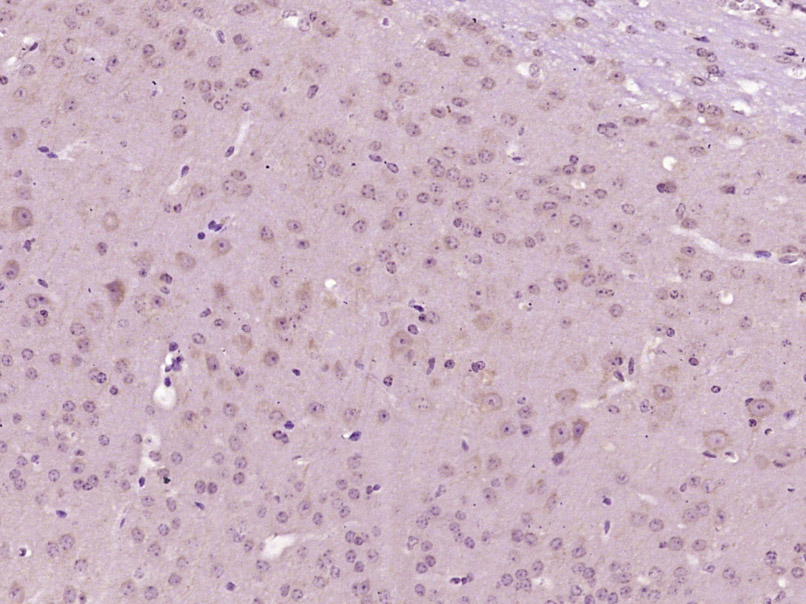
- 产品详情
- 实验流程
- 背景知识
Application 
| IHC-P, IHC-F, IF |
|---|---|
| Primary Accession | Q7Z333 |
| Reactivity | Mouse |
| Predicted | Rat, Dog, Human, Horse, Sheep |
| Host | Rabbit |
| Clonality | Polyclonal |
| Calculated MW | 302880 Da |
| Physical State | Liquid |
| Immunogen | KLH conjugated synthetic peptide derived from human Senataxin |
| Epitope Specificity | 321-398/2677 |
| Isotype | IgG |
| Purity | affinity purified by Protein A |
| Buffer | 0.01M TBS (pH7.4) with 1% BSA, 0.02% Proclin300 and 50% Glycerol. |
| SUBCELLULAR LOCATION | nucleolus. Cytoplasm. May be detected in the nucleolus only in cycling cells (By similarity). Most abundant in the nucleus. Detected in granules. Colocalized in cycling cells with FBL in the nucleolus. |
| DISEASE | Defects in SETX are the cause of spinocerebellar ataxia autosomal recessive type 1 (SCAR1) [MIM:606002]; also known as ataxia-ocular apraxia 2. Spinocerebellar ataxia is a clinically and genetically heterogeneous group of cerebellar disorders. Patients show progressive incoordination of gait and often poor coordination of hands, speech and eye movements, due to degeneration of the cerebellum with variable involvement of the brainstem and spinal cord. SCAR1 is an autosomal recessive form associated with peripheral neuropathy and elevated serum alpha-fetoprotein, immunoglobulins and, less commonly, creatine kinase levels. Some SCAR1 patients manifest oculomotor apraxia. Defects in SETX are a cause of amyotrophic lateral sclerosis type 4 (ALS4) [MIM:602433]. ALS4 is a familial form of amyotrophic lateral sclerosis, a neurodegenerative disorder affecting upper and lower motor neurons and resulting in fatal paralysis. Sensory abnormalities are absent. Death usually occurs within 2 to 5 years. The etiology of amyotrophic lateral sclerosis is likely to be multifactorial, involving both genetic and environmental factors. The disease is inherited in 5-10% of cases leading to familial forms. ALS4 is a childhood- or adolescent-onset form characterized by slow disease progression and the sparing of bulbar and respiratory muscles. |
| Important Note | This product as supplied is intended for research use only, not for use in human, therapeutic or diagnostic applications. |
| Background Descriptions | SETX belongs to the DNA2/NAM7 helicase family. Localizing to the nucleolus or the nucleoplasm in a cell cycle-dependent manner and to the cytoplasm, SETX contains a C-terminal DNA/RNA helicase domain and is believed to function as a helicase involved in RNA processing and DNA repair. Mutations in the gene encoding SETX can lead to ataxia-ocular apraxia 2 (AOA2) or amyotrophic lateral sclerosis 4 (ALS4). AOA2, also known as spinocerebellar ataxia-1 (SCAR1), is an autosomal recessive disorder characterized by progressive neurodegeneration of the cerebellum associated with the loss of Purkinje cells. ALS4 is a familial childhood- or adolescent-onset neurodegenerative disorder affecting both upper and lower motor neurons that ultimately results in fatal paralysis. |
| Gene ID | 23064 |
|---|---|
| Other Names | Helicase senataxin, 3.6.4.12, 3.6.4.13, Amyotrophic lateral sclerosis 4 protein, SEN1 homolog, Senataxin {ECO:0000303|PubMed:14770181, ECO:0000312|HGNC:HGNC:445}, SETX {ECO:0000303|PubMed:14770181, ECO:0000312|HGNC:HGNC:445} |
| Dilution | IHC-P=1:100-500,IHC-F=1:100-500,IF=1:100-500 |
| Storage | Store at -20 °C for one year. Avoid repeated freeze/thaw cycles. When reconstituted in sterile pH 7.4 0.01M PBS or diluent of antibody the antibody is stable for at least two weeks at 2-4 °C. |
For Research Use Only. Not For Use In Diagnostic Procedures.
| Name | SETX {ECO:0000303|PubMed:14770181, ECO:0000312|HGNC:HGNC:445} |
|---|---|
| Function | ATP-dependent 5'-3' helicase that preferentially unwinds RNA:DNA substrates over DNA:DNA substrates, playing a crucial role in resolving 5'-overhang RNA:DNA hybrids (R-loops) and promoting transcription termination (PubMed:36864660). Plays a role in transcription regulation by its ability to modulate RNA Polymerase II (Pol II) binding to chromatin and through its interaction with proteins involved in transcription (PubMed:19515850, PubMed:21700224). Contributes to the mRNA splicing efficiency and splice site selection (PubMed:19515850). Required for the resolution of R-loop RNA-DNA hybrid formation at G-rich pause sites located downstream of the poly(A) site, allowing XRN2 recruitment and XRN2-mediated degradation of the downstream cleaved RNA and hence efficient RNA polymerase II (RNAp II) transcription termination (PubMed:19515850, PubMed:21700224, PubMed:26700805). Required for the 3' transcriptional termination of PER1 and CRY2, thus playing an important role in the circadian rhythm regulation (By similarity). Involved in DNA double-strand breaks damage response generated by oxidative stress (PubMed:17562789). In association with RRP45, targets the RNA exosome complex to sites of transcription-induced DNA damage (PubMed:24105744). Plays a role in the development and maturation of germ cells: essential for male meiosis, acting at the interface of transcription and meiotic recombination, and in the process of gene silencing during meiotic sex chromosome inactivation (MSCI) (By similarity). May be involved in telomeric stability through the regulation of telomere repeat-containing RNA (TERRA) transcription (PubMed:21112256). Plays a role in neurite outgrowth in hippocampal cells through FGF8-activated signaling pathways. Inhibits retinoic acid-induced apoptosis (PubMed:21576111). |
| Cellular Location | Nucleus. Nucleus, nucleoplasm. Nucleus, nucleolus. Cytoplasm. Chromosome Chromosome, telomere. Cell projection, axon. Cell projection, growth cone. Note=May be detected in the nucleolus only in cycling cells. At pachytene stage, colocalizes predominantly to the heterochromatic XY-body of sex chromosomes with DNA damage response proteins in a BRCA1-dependent manner (By similarity). Localizes with telomeric DNA in a transcription-dependent manner (PubMed:21112256) Under replication stress, colocalizes with a variety of DNA damage signaling and repair response proteins at distinct nuclear foci in mitotic S/G2- and G1-phase cells in a transcription- and RNA/DNA hybrid-dependent manner (PubMed:23149945). Localizes at limited number of nuclear foci (PubMed:24105744). Colocalizes with EXOSC9 in nuclear foci upon induction of transcription-related DNA damage at the S phase (PubMed:24105744). Most abundant in the nucleus. Detected in granules Colocalized in cycling cells with FBL in the nucleolus {ECO:0000250|UniProtKB:A2AKX3, ECO:0000269|PubMed:17562789, ECO:0000269|PubMed:21112256, ECO:0000269|PubMed:21576111, ECO:0000269|PubMed:23149945, ECO:0000269|PubMed:24105744} |
| Tissue Location | Highly expressed in skeletal muscle. Expressed in heart, fibroblast, placenta and liver. Weakly expressed in brain and lung. Expressed in the cortex of the kidney (highly expressed in tubular epithelial cells but low expression in the glomerulus) |
Research Areas
Application Protocols
Provided below are standard protocols that you may find useful for product applications.
BACKGROUND
This product as supplied is intended for research use only, not for use in human, therapeutic or diagnostic applications.

终于等到您。ABCEPTA(百远生物)抗体产品。
点击下方“我要评价 ”按钮提交您的反馈信息,您的反馈和评价是我们最宝贵的财富之一,
我们将在1-3个工作日内处理您的反馈信息。
如有疑问,联系:0512-88856768 tech-china@abcepta.com.


