


 癌症的基本特征包括细胞增殖、血管生成、迁移、凋亡逃避机制和细胞永生等。找到癌症发生过程中这些通路的关键标记物和对应的抗体用于检测至关重要。
 为您推荐一个泛素化位点预测神器——泛素化分析工具,可以为您的蛋白的泛素化位点作出预测和评分。
 细胞自噬受体图形绘图工具为你的蛋白的细胞受体结合位点作出预测和评分,识别结合到自噬通路中的蛋白是非常重要的,便于让我们理解自噬在正常生理、病理过程中的作用,如发育、细胞分化、神经退化性疾病、压力条件下、感染和癌症。
KAT2A Rabbit mAb
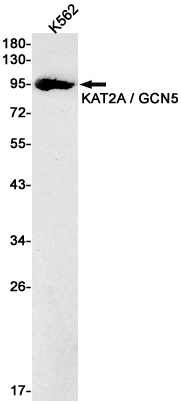
- 产品详情
- 实验流程
- 背景知识
Application 
| WB, IP |
|---|---|
| Primary Accession | Q92830 |
| Reactivity | Rat, Human, Mouse |
| Host | Rabbit |
| Clonality | Monoclonal Antibody |
| Isotype | IgG |
| Conjugate | Unconjugated |
| Purification | Affinity Purified |
| Calculated MW | 93926 Da |
| Gene ID | 2648 |
|---|---|
| Other Names | KAT2A |
| Dilution | WB~~1:500-1:1000 IP~~1:20-1:50 |
| Format | Liquid in 50mM Tris-Glycine(pH 7.4), 0.15M NaCl, 40%Glycerol, 0.01% sodium azide and 0.05% BSA. |
| Storage | Store at 4°C short term. Aliquot and store at -20°C long term. Avoid freeze/thaw cycles. |
For Research Use Only. Not For Use In Diagnostic Procedures.
| Name | KAT2A {ECO:0000303|PubMed:27796307, ECO:0000312|HGNC:HGNC:4201} |
|---|---|
| Function | Protein lysine acyltransferase that catalyzes acetylation of histone and non-histone proteins using acetyl-CoA (PubMed:16753578, PubMed:17301242, PubMed:21131905, PubMed:22465951, PubMed:23142079, PubMed:27796307, PubMed:29174768, PubMed:31527837, PubMed:35995428, PubMed:38128537, PubMed:27377381, PubMed:29211711, PubMed:37040526, PubMed:39561764, PubMed:39694035). Also catalyzes acyl-CoA-dependent acylation of lysine residues in proteins using alternative acyl-CoA donors, including propionyl-CoA, butyryl-CoA, succinyl-CoA, glutaryl- CoA, crotonyl-CoA and lactoyl-CoA (PubMed:31542297, PubMed:29211711, PubMed:37040526, PubMed:39561764). Acts as a histone lysine succinyltransferase: catalyzes succinylation of histone H3 on 'Lys-79' (H3K79succ), with a maximum frequency around the transcription start sites of genes (PubMed:29211711). Succinylation of histones gives a specific tag for epigenetic transcription activation (PubMed:29211711). Association with the 2-oxoglutarate dehydrogenase complex, which provides succinyl-CoA, is required for histone succinylation (PubMed:29211711). In different complexes, functions either as an acetyltransferase (HAT) or as a succinyltransferase: in the SAGA and ATAC complexes, acts as a histone acetyltransferase (PubMed:17301242, PubMed:19103755, PubMed:29211711). Has significant histone acetyltransferase activity with core histones, but not with nucleosome core particles (PubMed:17301242, PubMed:19103755, PubMed:21131905). Has a a strong preference for acetylation of H3 at 'Lys-9' (H3K9ac) (PubMed:21131905). Also catalyzes acetylation of histone H1.4 (H1-4) at 'Lys-34' (H1.4K34ac), a modification enriched at promoters of active genes (PubMed:22465951). Acetylation of histones gives a specific tag for epigenetic transcription activation (PubMed:17301242, PubMed:19103755, PubMed:29211711). Recruited by the XPC complex at promoters, where it specifically mediates acetylation of histone variant H2A.Z.1/H2A.Z, thereby promoting expression of target genes (PubMed:29973595, PubMed:31527837). Involved in long-term memory consolidation and synaptic plasticity: acts by promoting expression of a hippocampal gene expression network linked to neuroactive receptor signaling (By similarity). Acts as a positive regulator of T-cell activation: upon TCR stimulation, recruited to the IL2 promoter following interaction with NFATC2 and catalyzes acetylation of histone H3 at 'Lys-9' (H3K9ac), leading to promote IL2 expression (By similarity). Required for growth and differentiation of craniofacial cartilage and bone by regulating acetylation of histone H3 at 'Lys-9' (H3K9ac) (By similarity). Regulates embryonic stem cell (ESC) pluripotency and differentiation (By similarity). Also acetylates non- histone proteins, such as CEBPB, CGAS, MRE11, PPARGC1A, PLK4 and TBX5 (PubMed:16753578, PubMed:17301242, PubMed:27796307, PubMed:29174768, PubMed:38128537, PubMed:39694035). Involved in heart and limb development by mediating acetylation of TBX5, acetylation regulating nucleocytoplasmic shuttling of TBX5 (PubMed:29174768). Acts as a negative regulator of centrosome amplification by mediating acetylation of PLK4 (PubMed:27796307). Acts as a negative regulator of gluconeogenesis by mediating acetylation and subsequent inactivation of PPARGC1A (PubMed:16753578, PubMed:23142079). Acts as a positive regulator of cGAS-STING signaling by mediating acetylation and activation of CGAS (PubMed:39694035). Also acts as a histone glutaryltransferase: catalyzes glutarylation of histone H4 on 'Lys-91' (H4K91glu), a mark that destabilizes nucleosomes by promoting dissociation of the H2A-H2B dimers from nucleosomes (PubMed:31542297). Catalyzes histone H3 lactylation at 'Lys-14' and 'Lys-18' in a lactyl- CoA-dependent manner (PubMed:39561764). Lactyl-CoA for this reaction can be generated by ACSS2 (PubMed:39561764). |
| Cellular Location | Nucleus. Chromosome Cytoplasm, cytoskeleton, microtubule organizing center, centrosome. Note=Mainly localizes to the nucleus (PubMed:27796307). Localizes to sites of DNA damage (PubMed:25593309) Also localizes to centrosomes in late G1 and around the G1/S transition, coinciding with the onset of centriole formation (PubMed:27796307). |
| Tissue Location | Expressed in all tissues tested. |
Research Areas
Application Protocols
Provided below are standard protocols that you may find useful for product applications.
BACKGROUND
KAT2A, or GCN5, is a histone acetyltransferase (HAT) that functions primarily as a transcriptional activator. It also functions as a repressor of NF-kappa-B (see MIM 164011) by promoting ubiquitination of the NF-kappa-B subunit RELA (MIM 164014) in a HAT-independent manner (Mao et al., 2009 [PubMed 19339690]).

终于等到您。ABCEPTA(百远生物)抗体产品。
点击下方“我要评价 ”按钮提交您的反馈信息,您的反馈和评价是我们最宝贵的财富之一,
我们将在1-3个工作日内处理您的反馈信息。
如有疑问,联系:0512-88856768 tech-china@abcepta.com.
¥ 1,250.00
Cat# AP75480


