


 癌症的基本特征包括细胞增殖、血管生成、迁移、凋亡逃避机制和细胞永生等。找到癌症发生过程中这些通路的关键标记物和对应的抗体用于检测至关重要。
 为您推荐一个泛素化位点预测神器——泛素化分析工具,可以为您的蛋白的泛素化位点作出预测和评分。
 细胞自噬受体图形绘图工具为你的蛋白的细胞受体结合位点作出预测和评分,识别结合到自噬通路中的蛋白是非常重要的,便于让我们理解自噬在正常生理、病理过程中的作用,如发育、细胞分化、神经退化性疾病、压力条件下、感染和癌症。
TNFRSF14 Antibody
- 产品详情
- 实验流程
- 背景知识
Application 
| WB, IF, E, IHC-P |
|---|---|
| Primary Accession | Q92956 |
| Other Accession | Q92956, 13878821 |
| Reactivity | Human, Mouse |
| Host | Rabbit |
| Clonality | Polyclonal |
| Isotype | IgG |
| Calculated MW | 30392 Da |
| Concentration (mg/ml) | 1 mg/mL |
| Conjugate | Unconjugated |
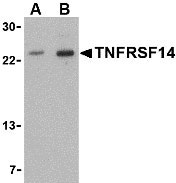
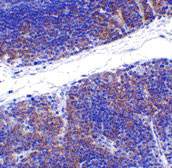
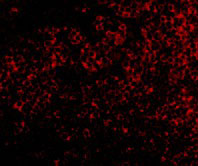
| Application Notes | TNFRSF14 antibody can be used for the detection of TNFRSF14 by Western blot at 1 - 2 µg/mL. Antibody can also be used for immunohistochemistry starting at 1 µg/mL. For immunofluorescence start at 10 µg/mL. |
| Gene ID | 8764 |
|---|---|
| Other Names | TNFRSF14 Antibody: TR2, ATAR, HVEA, HVEM, CD270, LIGHTR, UNQ329/PRO509, Tumor necrosis factor receptor superfamily member 14, Herpes virus entry mediator A, Herpesvirus entry mediator A, tumor necrosis factor receptor superfamily, member 14 (herpesvirus entry mediator) |
| Target/Specificity | TNFRSF14; Multiple isoforms of TNFRSF14 are known to exist. |
| Reconstitution & Storage | TNFRSF14 antibody can be stored at 4℃ for three months and -20℃, stable for up to one year. As with all antibodies care should be taken to avoid repeated freeze thaw cycles. Antibodies should not be exposed to prolonged high temperatures. |
| Precautions | TNFRSF14 Antibody is for research use only and not for use in diagnostic or therapeutic procedures. |
For Research Use Only. Not For Use In Diagnostic Procedures.
| Name | TNFRSF14 (HGNC:11912) |
|---|---|
| Function | Receptor for four distinct ligands: The TNF superfamily members TNFSF14/LIGHT and homotrimeric LTA/lymphotoxin-alpha and the immunoglobulin superfamily members BTLA and CD160, altogether defining a complex stimulatory and inhibitory signaling network (PubMed:10754304, PubMed:18193050, PubMed:23761635, PubMed:9462508). Signals via the TRAF2-TRAF3 E3 ligase pathway to promote immune cell survival and differentiation (PubMed:19915044, PubMed:9153189, PubMed:9162022). Participates in bidirectional cell-cell contact signaling between antigen presenting cells and lymphocytes. In response to ligation of TNFSF14/LIGHT, delivers costimulatory signals to T cells, promoting cell proliferation and effector functions (PubMed:10754304). Interacts with CD160 on NK cells, enhancing IFNG production and anti-tumor immune response (PubMed:23761635). In the context of bacterial infection, acts as a signaling receptor on epithelial cells for CD160 from intraepithelial lymphocytes, triggering the production of antimicrobial proteins and pro-inflammatory cytokines (By similarity). Upon binding to CD160 on activated CD4+ T cells, down- regulates CD28 costimulatory signaling, restricting memory and alloantigen-specific immune response (PubMed:18193050). May interact in cis (on the same cell) or in trans (on other cells) with BTLA (By similarity) (PubMed:19915044). In cis interactions, appears to play an immune regulatory role inhibiting in trans interactions in naive T cells to maintain a resting state. In trans interactions, can predominate during adaptive immune response to provide survival signals to effector T cells (By similarity) (PubMed:19915044). |
| Cellular Location | Cell membrane; Single-pass type I membrane protein |
| Tissue Location | Widely expressed, with the highest expression in lung, spleen and thymus. Expressed in a subpopulation of B cells and monocytes (PubMed:18193050). Expressed in naive T cells (PubMed:19915044). |
Provided below are standard protocols that you may find useful for product applications.
BACKGROUND
TNFRSF14 Antibody: Tumor necrosis factor receptor (TNFR) superfamily members are defined by cysteine-rich domains in their extracellular regions that bind TNF-related ligands that share a common structural homology in their extracellular domain. TNFRSF14 was initially identified as the Herpesvirus entry mediator and upon binding to the herpes simplex virus (HSV) envelope glycoprotein D or either of its natural ligands LIGHT and lymphotoxin alpha (LT), activates the transcription factors NF-κB and AP-1. Activation of this signal transduction pathway in T cells stimulates T cell proliferation and cytokine production, leading to inflammation and enhanced CTL-mediated tumor immunity, suggesting that these proteins may be useful as potential targets for controlling cellular immune responses.
REFERENCES
Montgomery RI, Warner MS, Lum BJ, et al. Herpes simplex virus-1 entry into cells mediated by a novel member of the TNF/NGF receptor family. Cell 1996; 87:427-36.
Montgomery RI, Warner MS, Lum BJ, et al. Herpes simplex virus-1 entry into cells mediated by a novel member of the TNF/NGF receptor family. Cell 1996; 87:427-36.
Marsters SA, Ayres TM, Skubatch M, et al. Herpesvirus entry mediator, a member of the tumor necrosis factor receptor (TNFR) family, interacts with members of the TNFR-associated factor family and activates the transcription factors NF-κB and AP-1. J. Biol. Chem. 1997; 272:14029-32.
Mauri DN, Ebner R, Montgomery RI, et al. LIGHT, a new member of the TNF superfamily, and lymphotoxin alpha are ligands for herpesvirus entry mediator. Immunity 1998; 8:21-30.

终于等到您。ABCEPTA(百远生物)抗体产品。
点击下方“我要评价 ”按钮提交您的反馈信息,您的反馈和评价是我们最宝贵的财富之一,
我们将在1-3个工作日内处理您的反馈信息。
如有疑问,联系:0512-88856768 tech-china@abcepta.com.


