


 癌症的基本特征包括细胞增殖、血管生成、迁移、凋亡逃避机制和细胞永生等。找到癌症发生过程中这些通路的关键标记物和对应的抗体用于检测至关重要。
 为您推荐一个泛素化位点预测神器——泛素化分析工具,可以为您的蛋白的泛素化位点作出预测和评分。
 细胞自噬受体图形绘图工具为你的蛋白的细胞受体结合位点作出预测和评分,识别结合到自噬通路中的蛋白是非常重要的,便于让我们理解自噬在正常生理、病理过程中的作用,如发育、细胞分化、神经退化性疾病、压力条件下、感染和癌症。
CAPS1 Antibody
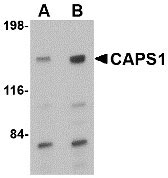
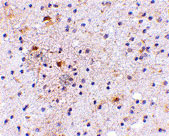
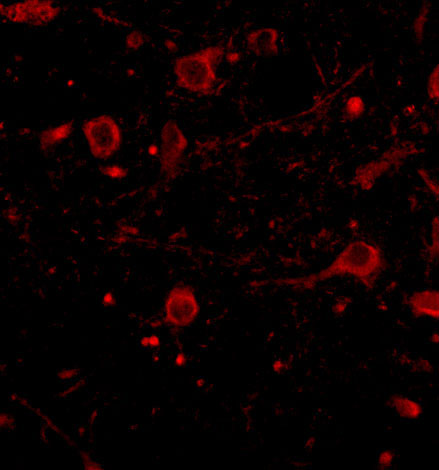
- 产品详情
- 实验流程
- 背景知识
Application 
| WB, IF, E, IHC-P |
|---|---|
| Primary Accession | Q9ULU8 |
| Other Accession | NP_899631, 34452713 |
| Reactivity | Human, Mouse, Rat |
| Host | Rabbit |
| Clonality | Polyclonal |
| Isotype | IgG |
| Calculated MW | 152786 Da |
| Concentration (mg/ml) | 1 mg/mL |
| Conjugate | Unconjugated |
| Application Notes | CAPS1 antibody can be used for detection of CAPS1 by Western blot at 0.5 - 1 µg/mL. Antibody can also be used for immunohistochemistry starting at 5 µg/mL. For immunofluorescence start at 20 µg/mL. |
| Gene ID | 8618 |
|---|---|
| Other Names | Calcium-dependent secretion activator 1, Calcium-dependent activator protein for secretion 1, CAPS-1, CADPS, CAPS, CAPS1, KIAA1121 |
| Target/Specificity | CADPS; Numerous isoforms of CAPS1 are known to exist; the lower molecular weight bands seen in the immunoblot image are likely to be these isoforms. This CAPS1 antibody is predicted to be specific to CAPS1 and not recognize CAPS2. |
| Reconstitution & Storage | CAPS1 antibody can be stored at 4℃ for three months and -20℃, stable for up to one year. As with all antibodies care should be taken to avoid repeated freeze thaw cycles. Antibodies should not be exposed to prolonged high temperatures. |
| Precautions | CAPS1 Antibody is for research use only and not for use in diagnostic or therapeutic procedures. |
For Research Use Only. Not For Use In Diagnostic Procedures.
| Name | CADPS |
|---|---|
| Synonyms | CAPS, CAPS1, KIAA1121 |
| Function | Calcium-binding protein involved in exocytosis of vesicles filled with neurotransmitters and neuropeptides. Probably acts upstream of fusion in the biogenesis or maintenance of mature secretory vesicles. Regulates catecholamine loading of DCVs. May specifically mediate the Ca(2+)-dependent exocytosis of large dense-core vesicles (DCVs) and other dense-core vesicles by acting as a PtdIns(4,5)P2- binding protein that acts at prefusion step following ATP-dependent priming and participates in DCVs-membrane fusion. However, it may also participate in small clear synaptic vesicles (SVs) exocytosis and it is unclear whether its function is related to Ca(2+) triggering (By similarity). |
| Cellular Location | Synapse {ECO:0000250|UniProtKB:Q62717}. Cytoplasmic vesicle, secretory vesicle, neuronal dense core vesicle membrane {ECO:0000250|UniProtKB:Q62717}; Peripheral membrane protein {ECO:0000250|UniProtKB:Q62717}. Note=Membrane-associated to vesicles Strongly enriched in synaptic fractions. Preferentially binds to dense core vesicles but not to synaptic vesicles. Binds phosphoinosides, with a strong selectivity for PtdIns(4,5)P2 over PtdIns(3,4,5)P3. Probably localizes to different vesicles compared to CADPS2 {ECO:0000250|UniProtKB:Q62717} |
| Tissue Location | Specifically expressed in neural and endocrine secretory tissues. Expressed in brain and pancreas and at low level in heart. Also expressed in fetal heart, cerebellum, cerebral cortex, medulla, occipital pole, frontal and temporal lobes, and putamen, as well as weak expression in spinal cord. |
Provided below are standard protocols that you may find useful for product applications.
BACKGROUND
CAPS1 Antibody: CAPS1 and its related protein CAPS2 encode novel neural/endocrine-specific cytosolic and peripheral membrane proteins. Both are essential components of the synaptic vesicle priming machinery and are required for the Ca2+-regulated exocytosis of secretory vesicles; CAPS-deficienct neurons contain no or very few fusion competent synaptic vesicles, causing a selective impairment of fast phasic transmitter release. CAPS1 acts at a stage in exocytosis that follows ATP-dependent priming, which involves the essential synthesis of phosphatidylinositol 4, 5-bisphosphate and is thought to be a specific regulator of large dense-core vesicle fusion.
REFERENCES
Walent JH, Porter BW, and Martin TF. A novel 145 kD brain cytosolic protein reconstitutes Ca(2+)-regulated secretion in permeable neuroendocrine cells. Cell1992; 70:765-775.
Juckusch WJ, Speidel D, Sigler A, et al. CAPS-1 and CAPS-2 are essential synaptic vesicle priming proteins. Cell2007; 131:796-808.
Rupnick M, Kreft M, Sikdat SK, et al. Rapid regulated dense-core vesicle exocytosis requires the CAPS protein. Proc. Natl. Acad. Sci. USA2000; 97:5627-32.

终于等到您。ABCEPTA(百远生物)抗体产品。
点击下方“我要评价 ”按钮提交您的反馈信息,您的反馈和评价是我们最宝贵的财富之一,
我们将在1-3个工作日内处理您的反馈信息。
如有疑问,联系:0512-88856768 tech-china@abcepta.com.


