


 癌症的基本特征包括细胞增殖、血管生成、迁移、凋亡逃避机制和细胞永生等。找到癌症发生过程中这些通路的关键标记物和对应的抗体用于检测至关重要。
 为您推荐一个泛素化位点预测神器——泛素化分析工具,可以为您的蛋白的泛素化位点作出预测和评分。
 细胞自噬受体图形绘图工具为你的蛋白的细胞受体结合位点作出预测和评分,识别结合到自噬通路中的蛋白是非常重要的,便于让我们理解自噬在正常生理、病理过程中的作用,如发育、细胞分化、神经退化性疾病、压力条件下、感染和癌症。
Stella Antibody
- 产品详情
- 实验流程
- 背景知识
Application 
| WB, E |
|---|---|
| Primary Accession | Q6W0C5 |
| Other Accession | NP_954980, 40548326 |
| Reactivity | Human, Mouse, Rat |
| Host | Rabbit |
| Clonality | Polyclonal |
| Isotype | IgG |
| Calculated MW | 17851 Da |
| Concentration (mg/ml) | 1 mg/mL |
| Conjugate | Unconjugated |
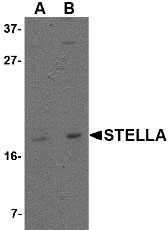
| Application Notes | Stella antibody can be used for detection of Stella by Western blot at 1 - 2 µg/mL. |
| Gene ID | 359787 |
|---|---|
| Other Names | Developmental pluripotency-associated protein 3, Stella-related protein, DPPA3, STELLAR |
| Target/Specificity | DPPA3; |
| Reconstitution & Storage | Stella antibody can be stored at 4℃ for three months and -20℃, stable for up to one year. As with all antibodies care should be taken to avoid repeated freeze thaw cycles. Antibodies should not be exposed to prolonged high temperatures. |
| Precautions | Stella Antibody is for research use only and not for use in diagnostic or therapeutic procedures. |
For Research Use Only. Not For Use In Diagnostic Procedures.
| Name | DPPA3 |
|---|---|
| Synonyms | STELLAR |
| Function | Primordial germ cell (PGCs)-specific protein involved in epigenetic chromatin reprogramming in the zygote following fertilization (PubMed:35314832). In zygotes, DNA demethylation occurs selectively in the paternal pronucleus before the first cell division, while the adjacent maternal pronucleus and certain paternally-imprinted loci are protected from this process (By similarity). Participates in protection of DNA methylation in the maternal pronucleus by preventing conversion of 5mC to 5hmC: specifically recognizes and binds histone H3 dimethylated at 'Lys-9' (H3K9me2) on maternal genome, and protects maternal genome from TET3-mediated conversion to 5hmC and subsequent DNA demethylation (By similarity). Does not bind paternal chromatin, which is mainly packed into protamine and does not contain much H3K9me2 mark (By similarity). Also protects imprinted loci that are marked with H3K9me2 in mature sperm from DNA demethylation in early embryogenesis (By similarity). May be important for the totipotent/pluripotent states continuing through preimplantation development (By similarity). Also involved in chromatin condensation in oocytogenesis (By similarity). |
| Cellular Location | Nucleus. Cytoplasm. Note=Mainly localizes in the female pronucleus, localization to the male pronucleus in much weaker {ECO:0000250|UniProtKB:Q8QZY3} |
| Tissue Location | Low expression in testis, ovary and thymus. Expressed in embryonic stem and carcinoma cells. Highly expressed in testicular germ cell tumors. |
Provided below are standard protocols that you may find useful for product applications.
BACKGROUND
Stella Antibody: Stella was initially identified in primordial germ cells and pre-implantation embryos whose expression as a maternal factor is important in early embryonic development but is not required for germ cell specification in mice. In humans, Stella is thought to be a marker for pluripotency in embryonic stem (ES) cells as its expression is observed in primordial germ cells of both sexes and germ cell tumors but not in normal somatic tissues. However, in ES cell colonies, heterogeneous expression of Stella was seen in high throughput in situ hybridization assays, indicating that higher levels of complexity exist in otherwise thought to be undifferentiated ES cells. At least two distinct isoforms of Stella are known to exist.
REFERENCES
Sato M, Kimura T, Kurokawa K, et al. Identification of PGC7, a new gene expressed specifically in preimplatation embryos and germ cells. Mech. Dev.2002; 113:91-4.
Bortvin A, Goodheart M, Liao M, et al. Dppa3/Pgc7/stella is a maternal factor and is not required for germ cell specification in mice. BMC Dev. Biol.2004; 4:2.
Bowles J, Teasdale RP, James K, et al. Dppa3 is a marker of pluripotency and has a human homologue that is expressed in germ cell tumours. Cytogenet. Genome Res.2003; 101:261-5.
Carter MG, Stagg CA, Falco G, et al. An in situ hybridization-based screen for heterogeneously expressed genes in mouse ES cells. Gene Expr. Patterns2008; 8:181-8.

终于等到您。ABCEPTA(百远生物)抗体产品。
点击下方“我要评价 ”按钮提交您的反馈信息,您的反馈和评价是我们最宝贵的财富之一,
我们将在1-3个工作日内处理您的反馈信息。
如有疑问,联系:0512-88856768 tech-china@abcepta.com.


