


 癌症的基本特征包括细胞增殖、血管生成、迁移、凋亡逃避机制和细胞永生等。找到癌症发生过程中这些通路的关键标记物和对应的抗体用于检测至关重要。
 为您推荐一个泛素化位点预测神器——泛素化分析工具,可以为您的蛋白的泛素化位点作出预测和评分。
 细胞自噬受体图形绘图工具为你的蛋白的细胞受体结合位点作出预测和评分,识别结合到自噬通路中的蛋白是非常重要的,便于让我们理解自噬在正常生理、病理过程中的作用,如发育、细胞分化、神经退化性疾病、压力条件下、感染和癌症。
NALP5 Antibody
- 产品详情
- 实验流程
- 背景知识
Application 
| WB, IF, E, IHC-P |
|---|---|
| Primary Accession | P59047 |
| Other Accession | NP_703148, 158321897 |
| Reactivity | Human, Mouse, Rat |
| Host | Rabbit |
| Clonality | Polyclonal |
| Isotype | IgG |
| Calculated MW | 134342 Da |
| Concentration (mg/ml) | 1 mg/mL |
| Conjugate | Unconjugated |
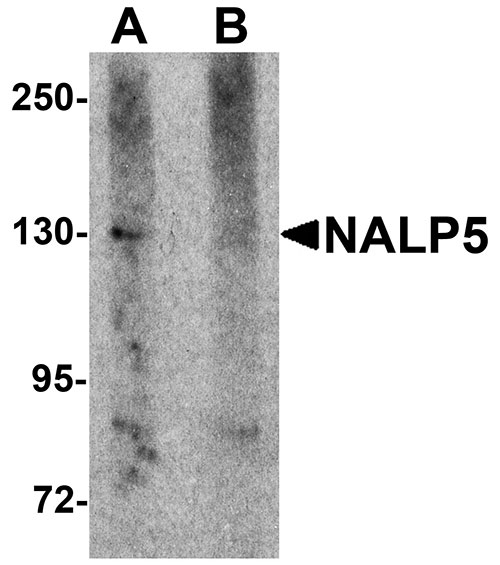
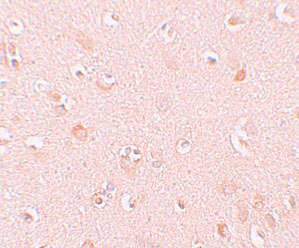
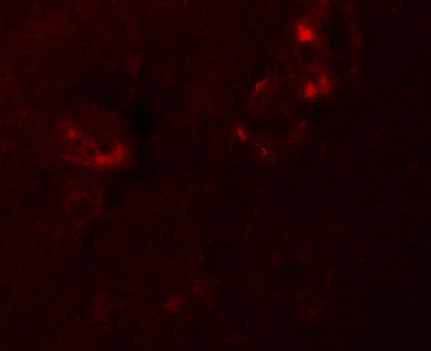
| Application Notes | NALP5 antibody can be used for detection of NALP5 by Western blot at 1 µg/mL. Antibody can also be used for immunohistochemistry starting at 10 µg/mL. For immunofluorescence start at 20 µg/mL. |
| Other Names | NACHT, LRR and PYD domains-containing protein 5, Mater protein homolog, NLRP5, MATER, NALP5 |
|---|---|
| Target/Specificity | NLRP5; |
| Reconstitution & Storage | NALP5 antibody can be stored at 4℃ for three months and -20℃, stable for up to one year. As with all antibodies care should be taken to avoid repeated freeze thaw cycles. Antibodies should not be exposed to prolonged high temperatures. |
| Precautions | NALP5 Antibody is for research use only and not for use in diagnostic or therapeutic procedures. |
For Research Use Only. Not For Use In Diagnostic Procedures.
| Name | NLRP5 {ECO:0000303|PubMed:38868925, ECO:0000312|HGNC:HGNC:21269} |
|---|---|
| Function | Component of the subcortical maternal complex (SCMC), a multiprotein complex that plays a key role in early embryonic development (PubMed:38868925). The SCMC complex is a structural constituent of cytoplasmic lattices, which consist in fibrous structures found in the cytoplasm of oocytes and preimplantation embryos (PubMed:41118754). They are required to store maternal proteins critical for embryonic development, such as ribosomal proteins, cytoskeletal tubulins and proteins controlling epigenetic reprogramming of the preimplantation embryo, in a poised but restrained state, regulating their availability for early embryonic development (PubMed:24374158, PubMed:38868925). Cytoplasmic lattices also tightly control ubiquitination during the oocyte-to-embryo transition by trapping E3 ubiquitin-protein ligase UHRF1 in a compact autoinhibited conformation and maintaining SCF ubiquitin ligase complexes inactive (PubMed:38868925). Required for the localization of cortical granules to the cortex of oocytes, via association with the cortical actin scaffold (By similarity). Required for cortical actin clearance prior to oocyte exocytosis and prevention of polyspermy (By similarity). Involved in regulating post-fertilization Ca(2+) release and endoplasmic reticulum storage (ER) storage via regulation of cellular localization (By similarity). May be involved in the localization of mitochondria to the cytoplasm and perinuclear region in oocytes and early stage embryos, independent of its role in CPL formation (By similarity). |
| Cellular Location | Cytoplasm. Cytoplasmic vesicle, secretory vesicle, Cortical granule. Mitochondrion. Nucleus, nucleolus. Golgi apparatus. Note=Core component of cytoplasmic lattices in oocytes (PubMed:37922900). In the subcortical cytoplasm of early embryos from the 1-cell to the blastocyst stages (By similarity). From the 2-cell stage, still detected in the subcortex, but excluded from cell-cell contact regions (By similarity). Expression largely disappears in blastocysts (By similarity). Located in mitochondria and nucleoli in primary follicle oocytes (By similarity) {ECO:0000250|UniProtKB:Q9R1M5, ECO:0000269|PubMed:37922900} |
| Tissue Location | Expressed in cumulus cells (at protein level) (PubMed:19542546). Highly abundant in oocytes and early embryos, however poorly expressed in somatic tissues such as the liver and spinal cord (PubMed:11925379, PubMed:30877238) |
Provided below are standard protocols that you may find useful for product applications.
BACKGROUND
NALP5 Antibody: NALP proteins include the apoptosis regulator APAF1 (apoptotic protease activating factor 1) and mammalian NOD-LRR proteins and are thought to be involved in inflammation and reproduction. NALP5, also known as MATER, is a maternal gene required for early embryonic development in mice. Increased NALP5 expression was observed in two neuronal injury models, and transient expression of recombinant NALP5 in neurons induced caspase-3 activation and apoptosis, suggesting that NALP5 also plays a role in caspase activation and apoptosis in injured neurons, and may thus represent a novel target for therapeutic treatment in neurodegenerative disorders.
REFERENCES
Tschopp J, Martinon F, and Burns K. NALPs: a novel protein family involved in inflammation. Nat. Rev. Mol. Cell Biol.2003; 4:95-104.
Tian X, Pascal G, and Monget P. Evolution and functional divergence of NLRP genes in mammalian reproductive system. BMC Evol. Biol.2009; 9:202.
Tong ZB, Gold L, Pfeiffer KE, et al. Mater, a maternal effect gene required for early embryonic development in mice. Nat. Genet.2000; 26:267-8.
Frederick Lo C, Ning X, Gonzales C, et al. Induced expression of death domain genes NALP1 and NALP5 following neuronal injury. Biochem. Biophys. Res. Commun.2008; 366:664-9.

终于等到您。ABCEPTA(百远生物)抗体产品。
点击下方“我要评价 ”按钮提交您的反馈信息,您的反馈和评价是我们最宝贵的财富之一,
我们将在1-3个工作日内处理您的反馈信息。
如有疑问,联系:0512-88856768 tech-china@abcepta.com.


